
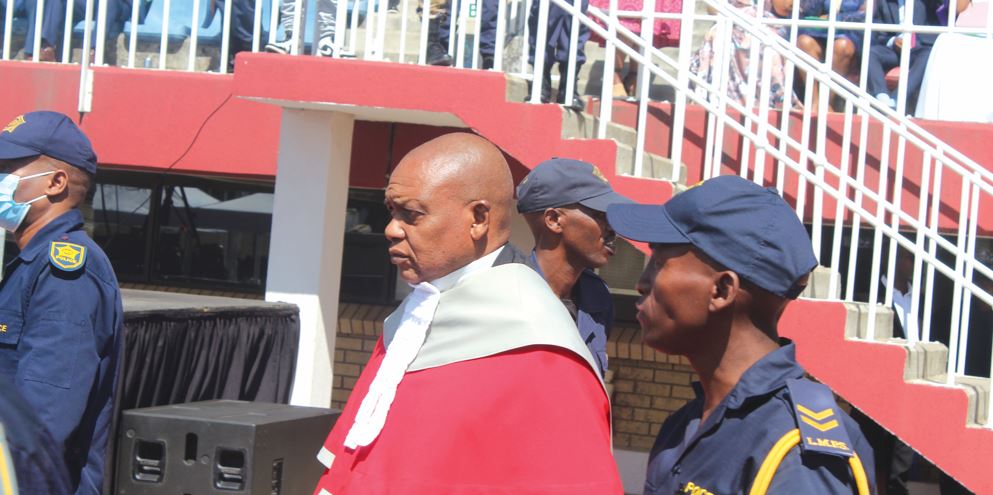
A High Court judge has sharply criticised what he described as a creeping erosion of judicial independence, insisting that Lesotho’s courts must remain free to decide cases without interference from the executive or legislative branches.
In remarks delivered during a contentious hearing, Judge Molefi Makara emphasised that courts are duty-bound to act impartially and without fear, favour or prejudice. “Courts should be seen to be independent of both the executive and the legislature,” he said.
The comments came as the High Court heard an urgent application filed by Prof. Kananelo Mosito, the suspended Pro Vice-Chancellor of the National University of Lesotho (NUL) and President of the Court of Appeal.
Prof. Mosito is seeking to block the university from recruiting a new Vice-Chancellor while the incumbent, Prof. Isaac Fajana, remains in office. His contract expires on July 31, 2026.Prof. Mosito argues that the university’s recruitment process, which was advertised on April 10 and closed on May 11, violates the National University of Lesotho Order of 1992.
That law, he contends, grants the Pro Vice-Chancellor the right to act in the Vice-Chancellor’s absence. The university proceeded with the search after Prof. Fajana informed officials in October 2025 that he would not seek a second term.
The case has raised delicate questions about judicial impartiality. The university has filed interlocutory applications challenging the High Court’s jurisdiction, arguing that the dispute belongs in the Labour Court. It has also sought the recusal of all High Court judges, citing Prof. Mosito’s dual role as President of the Court of Appeal, which reviews High Court decisions.
University lawyers contend that the relationship could compromise the judges’ ability to rule impartially and have asked for foreign judges to preside.
Judge Makara rejected the jurisdictional challenge, affirming that the High Court has authority over the matter. Rulings on the recusal application and a related request for a stay of execution remain pending.
In broader remarks from the bench, Judge Makara warned against any drift toward parliamentary supremacy at the expense of constitutional supremacy. “We are not under parliamentary supremacy,” he said. “We are under constitutional supremacy.”
The Latimer House Principles, a Commonwealth framework, governs relations among the three branches of government. The principles call for mutual respect, prohibit undue influence on the judiciary, and envision lawful checks and balances among the legislature, executive and judiciary.
There have been instances in which government institutions and ministries have failed to comply with court orders without facing contempt proceedings.
In 2022, a magistrate imprisoned a woman for defying a court order granting her ex-husband access to their child. The High Court upheld the contempt finding, praising the magistrate for protecting the dignity of the judiciary and rejecting the woman’s claim for compensation.
“Impartial courts are expected to protect rights and hold everybody found wanting to account,” Judge Makara said.
He expressed particular concern about efforts to restructure Lesotho’s legal framework in ways that could subordinate the judiciary.
“There is a challenge to re-architect the law in such a way that parliament is realistically independent of the executive,” he said. Overprotecting legislative intent, he warned, risks allowing the executive to dictate justice, especially given the country’s shifting political fortunes.
“The danger is that parliament can make a law establishing tribunals or specialised courts presided over by people friendly to the establishment,” Judge Makara added. “And whenever you come to this court, we simply say parliament has decreed it. This will characterise a danger.”
Chief Justice Sakoane Sakoane has previously cautioned against unsubstantiated attacks on judicial officers, stressing that public confidence in the judiciary depends on delivering judgments, even unpopular ones, in accordance with the rule of law.
The university’s case against Prof. Mosito, which also involves his suspension, continues to unfold, testing the boundaries of institutional autonomy and judicial authority in Lesotho’s young democracy.
Summary
- A High Court judge has sharply criticised what he described as a creeping erosion of judicial independence, insisting that Lesotho’s courts must remain free to decide cases without interference from the executive or legislative branches.
- The High Court upheld the contempt finding, praising the magistrate for protecting the dignity of the judiciary and rejecting the woman’s claim for compensation.
- “There is a challenge to re-architect the law in such a way that parliament is realistically independent of the executive,” he said.
Thoboloko Ntšonyane is a dedicated journalist who has contributed to various publications. He reports on accountability, human rights, exposes corruption and wrong doing by those in power. He reports have exposed corruption, abuse of power, fraud, misconduct and negligence. He subscribes to evidence-based reporting. He reports on governance, parliament, courts, climate change, human rights, sexual and reproductive health rights (SRHR), health, business and agriculture. He gives a voice to the marginalised while also demanding accountability. His work inspires change, triggers dialogue and also promote transparency in a society.