

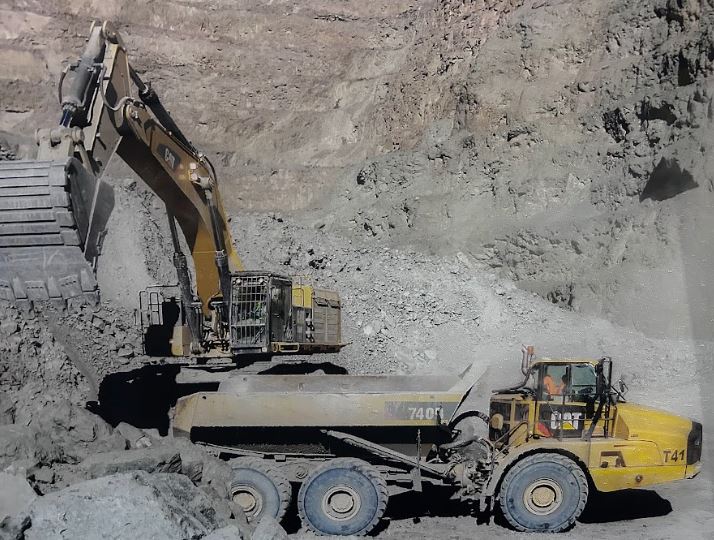
A prolonged collapse in global diamond prices is no longer just a mining story. According to the Central Bank of Lesotho (CBL), it has become a financial stability concern with implications for government finances, banks, businesses and households across the country. Lesotho’s diamond export revenues collapsed by 55.8 percent in just three years, falling to M2.3 billion by 2025.
The warning appears in the CBL’s latest Financial Stability Report, which paints a sobering picture of an economy heavily exposed to a commodity whose fortunes are increasingly being shaped by changing consumer preferences, laboratory-grown alternatives and weak global demand.
The report notes that diamonds remain central to Lesotho’s economy, accounting for around eight percent of gross domestic product (GDP) and contributing significantly to exports, government revenue and employment.
However, the global market has shifted dramatically since the post-Covid recovery period.
“Global diamond prices significantly declined between 2023 and 2025, reflecting weakening demand and structural changes in the global diamond industry,” the CBL says.
Demand has weakened in major consumer markets such as the United States, China and India, while laboratory-grown diamonds (LGDs) have emerged as a disruptive force.
According to the report, laboratory-grown diamonds cost “about 73 percent less than natural diamonds” and have rapidly gained market acceptance.
“The sale of LGD jewellery increased from 5.2 percent in 2019 to 41.1 percent in 2025,” the report states.
For natural diamond producers such as Lesotho, the implications have been severe.
Mines under pressure
The CBL says deteriorating market conditions have forced difficult decisions across Lesotho’s mining sector.
“Liqhobong and Mothae mines have halted operations and are at risk of permanent closures, while Letšeng and Kao mines are at risk of scaling back production and revised expenditure plans in response to weaker global market conditions.”
The consequences are already visible in the country’s export performance.
The report records “a sharp drop in diamond export revenues that fell by 55.8 percent to M2.3 billion between 2022 and 2025.”
At the same time, the mining sector contracted by five percent during the 2024/25 financial year.
The CBL observes that even where production volumes temporarily improved, low prices erased the gains.
“Although there is a brief recovery in carats sold around 2024, this did not translate into improved financial performance, as prices remained relatively low.”
The central bank adds that “most mining companies experienced a plunge in revenues, highlighting that higher volumes alone were insufficient to offset the impact of depressed prices.”
Fiscal pain reaches government coffers
One of the most significant findings in the report is the extent to which the diamond downturn is affecting government finances.
During the diamond boom of 2021 and 2022, Lesotho earned approximately M4.8 billion annually from diamond exports, equivalent to about 13 percent of GDP.
By 2025, however, export earnings had fallen to M2.3 billion, representing only 5.5 percent of GDP.
The impact on state revenue has been equally dramatic.
The report says government royalties from mining “fell sharply by 170 percent to M99 million between 2019 and 2025.”
While the percentage figure may warrant further clarification because declines cannot mathematically exceed 100 percent when measured from a starting point, the broader message from the report is clear that government income from mining has deteriorated significantly.
The CBL warns that reduced revenues could have knock-on effects throughout the economy.
“This weakened fiscal position could delay government repayments to suppliers and contractors, creating liquidity strains in other sectors of the economy.”
Those delays, in turn, could weaken businesses’ cash flows and increase credit risks across the financial system.
Why banks should be worried
The report’s most important warning is arguably not about mining itself, but about the financial sector.
The CBL identifies what economists call a transmission mechanism, the process through which problems in one sector spread into others.
“The financial strain within the mining sector is increasingly evident in credit performance,” the report says.
Since 2019, lending to the mining sector has fallen by approximately 52 percent to only M200 million.
At the centre of the concern is Letšeng Diamond Mine, one of Lesotho’s flagship mining operations.
According to the report, Letšeng’s debt-servicing capacity has deteriorated significantly.
“Over the same period, Lesotho’s largest mine, Letšeng Diamond Mine, has experienced a marked deterioration in debt-servicing capacity, with its debt-to-EBITDA ratio rising from below 1x to around 5x, largely driven by a sharp decline in earnings rather than an increase in debt.”
The mine’s challenges have already translated into employment losses.
“This weak performance of the mine has also resulted in over 200 job losses, amplifying economic stress beyond the mining sector.”
The central bank links these job losses directly to broader economic pressures.
“These layoffs have reduced household incomes, leading to lower consumption and generating spillover effects in linked sectors such as retail.”
For commercial banks, this creates a familiar problem: borrowers with shrinking incomes become less able to repay loans.
“As displaced workers and struggling businesses face reduced cash flows, their ability to service loans weakens, placing pressure on banks’ asset quality and profitability.”
The CBL warns that these developments “continue to elevate credit risk, constrain credit extension and dampen overall economic activity.”
A structural challenge, not a temporary downturn
Perhaps the most striking aspect of the report is its recognition that the challenges facing natural diamonds may not be cyclical alone.
The rise of laboratory-grown diamonds represents a structural shift in consumer behaviour.
Consumers, particularly younger buyers, are increasingly attracted to cheaper alternatives and are placing greater emphasis on environmental, social and governance considerations.
The report notes that concerns about the ESG impact of natural diamond mining have become one of the factors contributing to sustained pressure on prices.
This raises a difficult question for Lesotho: what happens if global demand for natural diamonds never returns to previous levels?
The CBL appears to acknowledge that possibility.
“The outlook for global diamond prices remains uncertain and growth in the market will largely depend on how players strategically position themselves to adapt to this evolving industry.”
The central bank’s prescription
The report suggests that survival will require adaptation rather than reliance on a market rebound.
It argues that natural diamond producers should focus on product differentiation, rarity and stronger ESG standards.
“To remain competitive, it is important for natural diamond producers to emphasize product differentiation through rarity, strengthen ESG standards, and build trust through traceability and responsible sourcing.”
More significantly, the CBL points to diversification as an increasingly urgent necessity.
“The need for diversification into LGDs or recycled diamonds to capture shifting consumer demand has become increasingly urgent.”
It also suggests exploring industrial and technological uses for diamonds beyond jewellery.
“Additionally, exploring alternative applications of diamonds in high-tech industries offers an opportunity to diversify revenue streams and reduce reliance on traditional jewellery markets.”
More than a mining problem
The central bank’s analysis amounts to a warning that the diamond downturn should no longer be viewed solely as a challenge for mining companies.
The report makes clear that falling diamond prices now have implications for fiscal sustainability, employment, household incomes, business liquidity and banking sector stability.
Summary
- The warning appears in the CBL’s latest Financial Stability Report, which paints a sobering picture of an economy heavily exposed to a commodity whose fortunes are increasingly being shaped by changing consumer preferences, laboratory-grown alternatives and weak global demand.
- “Liqhobong and Mothae mines have halted operations and are at risk of permanent closures, while Letšeng and Kao mines are at risk of scaling back production and revised expenditure plans in response to weaker global market conditions.
- One of the most significant findings in the report is the extent to which the diamond downturn is affecting government finances.

Lesotho activist and journalist who is the Chairperson of the Media Institute of Southern Africa (MISA) Lesotho. He is an International Visitor Leadership Program (IVLP) alumnus.
Boloetse is driven by the need to protect and promote the rights of others, especially the marginalized segment of society. He rose to prominence as an activist in 2018 when he wrote to Lesotho communications Authority (LCA) asking it to order Econet Telecom Lesotho (ETL) and Vodacom Lesotho (VCL) to stop charging expensive out-of-bundle rates for data when customers’ data bundles get depleted.