
Lesotho, long a fixture on the Southern African Development Community’s (SADC) security agenda, has been elected incoming chair of the SADC Organ on Politics, Defence and Security Cooperation.
The milestone shows how far the country has travelled politically since it last held the role in 2003/2004, although it later chaired the main SADC Summit in 2006/2007.
The decision was taken at an Extraordinary Summit of the Heads of State and Government, held virtually. The SADC Secretariat announced it on Wednesday this week.
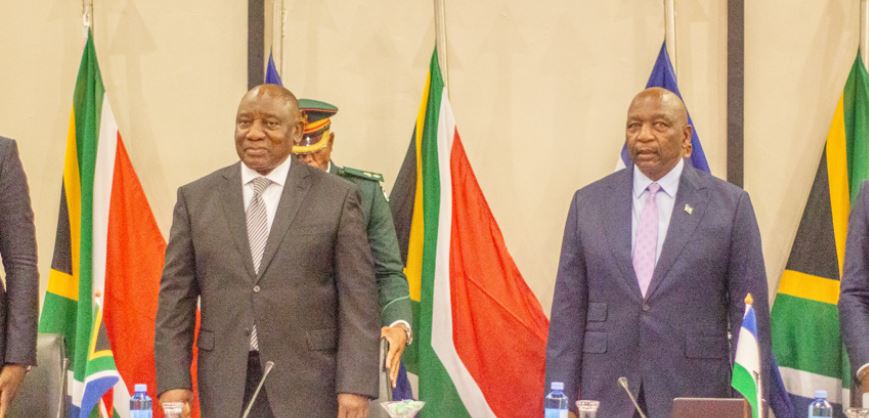
“The Extraordinary Summit of the Heads of State and Government of the Southern African Development Community (SADC) was held virtually on 21 October 2026 under the Chairpersonship of His Excellency Matamela Cyril Ramaphosa, President of the Republic of South Africa.
“Among the key decisions taken, Summit elected the Right Honourable Mr. Ntsokoane Samuel Matekane, Prime Minister of the Kingdom of Lesotho, as the Incoming Chairperson of the SADC Organ on Politics, Defence and Security Cooperation,” reads the SADC statement.
Prime Minister Ntsokoane Matekane will effectively be the Chairperson. He completes the body’s leadership Troika after the appointment was deferred at the bloc’s August summit this year.
He joins current chairperson King Mswati III of Eswatini and outgoing chair Prof Arthur Peter Mutharika, the Malawian President.
The Troika is a rotating leadership structure made up of the Organ’s current, incoming and outgoing chairs. It provides political direction and continuity on regional peace and security issues, and its chair, supported by the Secretariat, mediates in countries where there are disputes.
The Organ also promotes peace, stability, democracy and good governance, and coordinates SADC cooperation on political, defence and security matters, including efforts to address conflict and instability in member states.
In August, this publication reported that the nomination had been deferred. Foreign Affairs and International Relations Minister Limpho Tau then told this publication that Lesotho had formally applied for the post, writing to the SADC Secretariat on 4 March 2026 to declare its intention.
The Secretariat acknowledged the letter on 12 March 2026. Angola had also announced its interest in the position.
Lesotho last chaired the SADC bloc in 2006/2007 under then Prime Minister Pakalitha Mosisili. In 2014, at the Summit held at Victoria Falls in Zimbabwe, then Prime Minister Thomas Thabane was elected deputy chair of the Organ.
That same year, the country slid into crisis. On 30 August 2014, an attempted coup d’état saw the army seize the Maseru police station and broadcast stations, and Thabane fled to South Africa. SADC intervened with mediation and a facilitator, and later with oversight measures as instability persisted.
This included the 2015 killing of former army commander Maaparankoe Mahao by his juniors at Mokema, on the outskirts of Maseru. Reforms were then proposed for Lesotho, resulting in seven thematic areas aimed at professionalising institutions and promoting peace and political stability.
The national reforms process began in 2016 after SADC stepped in to help Lesotho address recurring instability, including the 2014 attempted coup and a series of politically motivated killings. That year, SADC described its engagement as helping Lesotho achieve lasting peace and security. It was regional monitoring and assistance, not a formal suspension.
The route was not smooth. In 2022 the courts unanimously nullified an earlier version of the Tenth Amendment because Parliament had not followed the procedures the Constitution sets for different types of amendment.
The turning point came in August 2025. At the 45th Summit, SADC removed Lesotho from the Organ Troika’s agenda, citing positive progress in the country’s political and security situation. Leaders commended the passage and enactment of the Tenth Amendment as a significant milestone towards near-finalisation of the national reforms process.
They also applauded the Panel of Elders, the Mediation Reference Group and the people of Lesotho for their commitment to consolidating peace and security. The amendment added provisions on affirmative action and public interest to the chapter on fundamental human rights.
Little more than a year later, a country that was once the subject of regional mediation has been chosen to help lead it. For a nation that spent more than a decade as a standing item on the Organ’s agenda, the shift from oversight to leadership is perhaps the clearest sign yet of the distance travelled since the turbulence of 2014 and 2015.
This also means that, as Lesotho assumes the Troika chairmanship, the country will host some of the Organ’s meetings. For many years, Lesotho has travelled across the SADC region to attend meetings hosted by countries whose leaders chair the Troika and the SADC bloc.
The Prime Minister’s Office called the 2025 decision a landmark achievement that brought hope and new energy to finalising the remaining reforms. Government commentary at the time said the decision restored Lesotho’s full stature as an equal partner within SADC.
The picture is not without dissent. After the 2025 decision, some opposition figures and civil society groups criticised it and prepared a legal challenge to the Tenth Amendment. In 2026, opposition parties petitioned SADC alleging that the government was defying court orders, and called for Lesotho to be returned to the Troika agenda.
Supporters of the reforms point out that SADC itself described the process as nearing completion, which leaves work still to be done. The chairmanship will test how far Lesotho has come. Leading the Organ means mediating other countries’ disputes, which calls for the credibility that comes from having dealt with one’s own.
“Summit further urged Member States to strengthen regional disaster preparedness, enhance anticipatory action and improve coordination in responding to emerging humanitarian risks across the region in anticipation of the cascading impacts of 2026/2027 El Niño and Cyclone Season in Southern Africa,” further reads the SADC statement.
Summary
- The milestone shows how far the country has travelled politically since it last held the role in 2003/2004, although it later chaired the main SADC Summit in 2006/2007.
- “The Extraordinary Summit of the Heads of State and Government of the Southern African Development Community (SADC) was held virtually on 21 October 2026 under the Chairpersonship of His Excellency Matamela Cyril Ramaphosa, President of the Republic of South Africa.
- Ntsokoane Samuel Matekane, Prime Minister of the Kingdom of Lesotho, as the Incoming Chairperson of the SADC Organ on Politics, Defence and Security Cooperation,” reads the SADC statement.
Thoboloko Ntšonyane is a dedicated journalist who has contributed to various publications. He reports on accountability, human rights, exposes corruption and wrong doing by those in power. He reports have exposed corruption, abuse of power, fraud, misconduct and negligence. He subscribes to evidence-based reporting. He reports on governance, parliament, courts, climate change, human rights, sexual and reproductive health rights (SRHR), health, business and agriculture. He gives a voice to the marginalised while also demanding accountability. His work inspires change, triggers dialogue and also promote transparency in a society.