
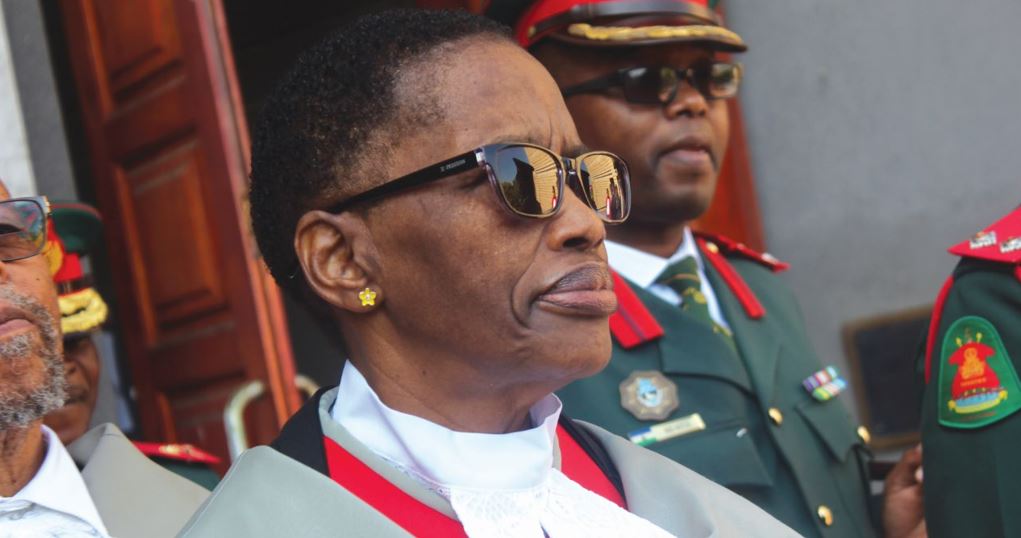
The Constitutional Court has dismissed an application by suspended judge ‘Maseforo Mahase to have three foreign judges recused from her case, dealing her a significant blow.
Judge Mahase had asked the court to remove Judge Boissie Henry Mbha, Judge Kamaga Ivy Chatha and Judge Latifa A. Mansour, three judges from the Southern African Development Community (SADC) region who have been brought in to hear her case. Her application cited them in their personal capacities.
In the application, Judge Mahase was the applicant, while Judge Mbha, Judge Chatha, Judge Mansoor and the Attorney-General were the first to fourth respondents respectively.
She sought an order, among others, that the three judges be “…recused from hearing, presiding over, or participating in any manner whatsoever…”, citing reasonable apprehension of bias.
She argued that a fair-minded and properly informed observer, aware of the facts, would conclude that there was a possibility “that the respondents cannot bring an impartial mind to bear on the adjudication of the main application”.
The Constitutional Court did not find in her favour and ordered her to pay costs on the punitive attorney-and-client scale.
The judgment states: “ A judge is under a constitutional duty to sit in matters assigned to them and must not recuse themselves simply because a litigant adopts an adversarial stance.
“By structurally citing us judges in a personal capacity, the applicant [Judge Mahase] attempted to build a legal trap to force the scenario forbidden….”
It continues: “In our view, her sudden swing to personal citation in the current motion exposes a deliberate intent to manufacture a conflict of interest ,manipulate the judicial schedule, and force this Court into an unwarranted recusal. Under both South African and Lesotho civil jurisprudence, such tactical moves represent the highest form of vexatious litigation.
“This in our view justifies punishing this conduct through an exemplary, punitive costs order. To this end, it is worth mentioning that a court’s power to award punitive costs is rooted in its inherent jurisdiction to prevent the subversion of its own mechanism,” reads the judgment.
The strongly worded judgment also referred to an earlier case in which Judge Mahase sought the recusal of a panel of then judges Tšeliso Monapathi, Semapo Peete and Kekeletso Moahloli. It states: “The primary indicator of the applicant’s bad faith is her own past litigation history.
In Madam Justice ‘Maseforo Mahase and Others v Lebohang Hlaele and Another, the application explicitly requested that the panel consisting of Monapathi J, Peete J, and Moahloli J, alongside the remaining judges of the Lesotho High Court Bench, recuse themselves so that foreign judges could be appointed.
“In those papers, the litigants dealt directly with institutional dynamics, raising arguments around “collegiality,” “close working relationships” and administrative friction between the Head of the Judiciary and junior judges.”
The court said it appreciated the rules governing judicial citation but was struck by her “total departure” from the established baseline in this case, “by structurally dragging our private persona” into the record. It added that courts have consistently penalised litigants who abuse procedural rules for “ulterior, strategic motives”.
The ruling said Judge Mahase had violated Section 118(2) of the Constitution, which protects the judiciary from external interference.
The court further ordered her to bear the costs of the postponement sine die (indefinitely) made on 29 May 2026. It said the postponement resulted from what it called the “sudden” and “unexpected” issue of the recusal of the entire bench.
“This turn of events was wholly at the instance of the applicant. The applicant must accordingly bear the costs of the postponement for that day,” reads the judgment.
Judge Mahase has been embroiled in a legal battle since 2025, when she was suspended from work. On 7 November 2025, High Court Registrar Advocate Mathato Sekoai issued a circular announcing that she had been suspended from the High Court bench with effect from 4 November.
She faces serious allegations, including claims that she assigned herself cases in which she had an interest and failed to deliver judgments within the 90-day period set out in High Court rules made by the Chief Justice in 2023. The allegations have raised concerns about whether her conduct may have compromised her professional standing.
She has also fought in the courts to have her suspension reversed and sought an interdiction against the tribunal expected to investigate her alleged misconduct.
Last year, Acting High Court Judge Sekake Malebanye removed her case from the roll of urgent matters, pointing to her failure to file the urgent application for interdiction.
Summary
- She argued that a fair-minded and properly informed observer, aware of the facts, would conclude that there was a possibility “that the respondents cannot bring an impartial mind to bear on the adjudication of the main application”.
- “In our view, her sudden swing to personal citation in the current motion exposes a deliberate intent to manufacture a conflict of interest ,manipulate the judicial schedule, and force this Court into an unwarranted recusal.
- In Madam Justice ‘Maseforo Mahase and Others v Lebohang Hlaele and Another, the application explicitly requested that the panel consisting of Monapathi J, Peete J, and Moahloli J, alongside the remaining judges of the Lesotho High Court Bench, recuse themselves so that foreign judges could be appointed.
Thoboloko Ntšonyane is a dedicated journalist who has contributed to various publications. He reports on accountability, human rights, exposes corruption and wrong doing by those in power. He reports have exposed corruption, abuse of power, fraud, misconduct and negligence. He subscribes to evidence-based reporting. He reports on governance, parliament, courts, climate change, human rights, sexual and reproductive health rights (SRHR), health, business and agriculture. He gives a voice to the marginalised while also demanding accountability. His work inspires change, triggers dialogue and also promote transparency in a society.