
Another major milestone has been reached in the construction of the Lesotho Highlands Water Project (LHWP) Phase II, with the Polihali Dam achieving a critical stage in its development.
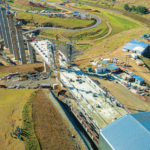
The dam has now reached a rockfill placement elevation of 1 977 metres, 65 metres above the riverbed, following an intense construction push in 2025 that saw more than six million cubic metres of rock placed by the end of November.
According to the Lesotho Highlands Development Authority (LHDA), the main dam wall is currently achieving a rockfill placement rate of over 22 000 cubic metres per day, an amount equivalent to filling nine Olympic-sized swimming pools daily.
The saddle dam is also advancing steadily, with more than 154 000 cubic metres of rock already placed.
In total, approximately 14 million cubic metres of rock will be required to complete the Polihali Dam. Once finished, it will be a concrete-faced rockfill dam larger than the 145-metre-high Mohale Dam constructed during Phase I of the LHWP.
The basal rock, each layer weighing about 3.5 tonnes per square metre, is sourced from a quarry located within the dam basin itself. Once the dam is inundated, the quarry will be completely submerged.
LHDA explained that blasting operations at the quarry are conducted with precision to ensure the rock is broken into optimal sizes.
This allows excavators to load the material directly onto dump trucks without additional processing before it is transported to the dam site, where it is placed and compacted in layers up to 0.8 metres thick.
Operating on a two-shift system, roughly 2 700 truckloads of rock are transported daily from the quarry to the dam embankment.
When completed, the Polihali Dam will surpass Mohale Dam, which was once the largest rockfill dam in Africa, in scale. The embankment will rise to 166 metres, with a crest measuring 921 metres in length and nine metres in width. At its base, the dam will span approximately 490 metres.
The dam’s associated infrastructure includes a spillway, intake tower, bottom outlet, compensation outlet structure, and a small hydropower station. It will create a vast reservoir on the Senqu and Khubelu rivers, covering a surface area of 5 053 hectares and holding up to 2 325 million cubic metres of water at full supply level.
Construction of the Polihali Dam is being carried out by the SUN Joint Venture, comprising China’s Sinohydro Bureau 8 and Sinohydro Bureau 14, South Africa’s Unik Civil Engineering, and Lesotho’s Nthane Brothers. Subcontractors include South Africa’s Melki Civils and Plant Hire and Mecsa Construction, Lesotho’s Sigma Construction, and China’s Kunming Engineering.
Supervision of the works is being undertaken by the Matla a Metsi Joint Venture, which includes South Africa’s GIBB and Mpamot Africa, France’s Tractebel Engineering SA/Coyne et Bellier, and Lesotho’s LYMA Consulting Engineers.
Once Phase II is complete, the LHWP will increase the annual water transfer capacity from 780 million cubic metres to 1 270 million cubic metres, helping to meet South Africa’s growing water demand.
At the same time, the increased water flows from Polihali are expected to boost hydropower generation in Lesotho, contributing to domestic electricity supply and reducing the country’s reliance on imported power.
As construction gathers pace, the Polihali Dam is fast emerging as one of the most significant infrastructure projects in the region, reshaping both Lesotho’s landscape and its strategic role in regional water and energy security.
Summary
- The dam has now reached a rockfill placement elevation of 1 977 metres, 65 metres above the riverbed, following an intense construction push in 2025 that saw more than six million cubic metres of rock placed by the end of November.
- It will create a vast reservoir on the Senqu and Khubelu rivers, covering a surface area of 5 053 hectares and holding up to 2 325 million cubic metres of water at full supply level.
- As construction gathers pace, the Polihali Dam is fast emerging as one of the most significant infrastructure projects in the region, reshaping both Lesotho’s landscape and its strategic role in regional water and energy security.

Authored by our expert team of writers and editors, with thorough research.