
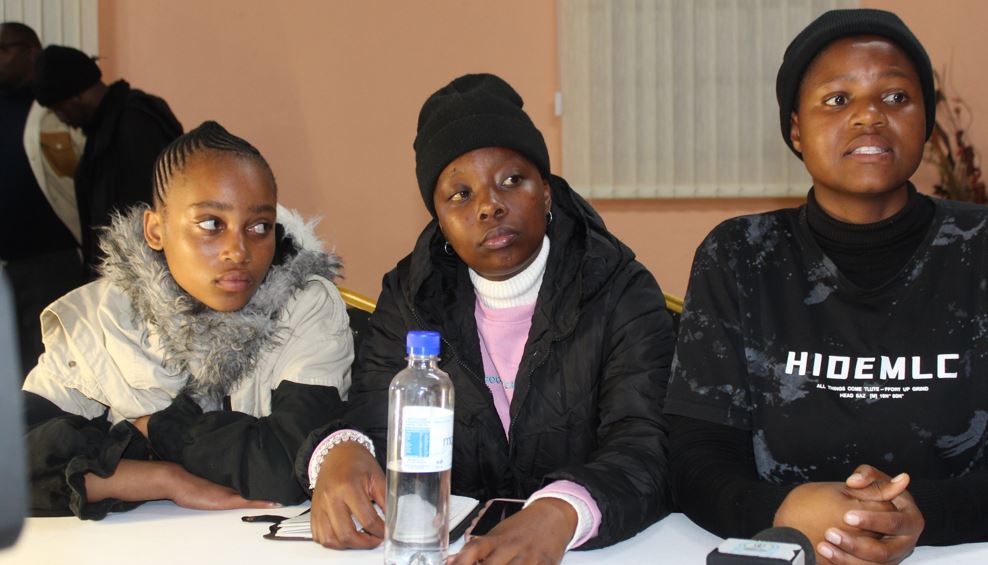
In a candid and at times heated meeting, young people in Thaba Tseka district sharply criticised parents for their role in perpetuating child marriage and gender-based violence (GBV), saying outdated mindsets and economic pressures continue to endanger girls’ futures.
The inter-ministerial meeting, held on Wednesday evening and attended by government officials, police, development partners including UNFPA, and youth representatives, gave young voices a direct platform to confront those in positions of power.
“Our parents are still stuck in the past”
Youth representative Likabo Lekhanya was uncompromising in her assessment. She placed much of the blame on parents who, she said, have failed to adapt to modern realities and the challenges facing today’s youth.
“Our parents are still stuck in the past and have not been moving with generations to understand the current time and the challenges that face youth in this generation,” Lekhanya said.
She painted a troubling picture of how some parents, often unknowingly, allow or even facilitate child marriages.
“Our parents sell us. In other times they are not even aware that they are selling us. This happens because in the district we live with many illegal miners who have a lot of money, and when such a man comes into their home and requests to marry a girl in the family, without even asking their age, they accept a huge sum of money. Just like that, they have sold their young girl to marriage without even thinking that it is illegal,” she explained.
Lekhanya added that many girls are married off to much older men they neither know nor are attracted to.
Girls’ own vulnerabilities
While holding parents accountable, Lekhanya acknowledged that girls also contribute to the problem.
“We as girls also contribute because in some cases we allow that to happen due to lack of self-esteem and also not standing for what we really want.”
Poverty, she said, is another reason why girls accept early marriage. “By getting married, girls believe they will live the life they envy from other people or even their peers who got married before them.”
Lekhanya shared that it is not only illegal miners who prey on girls. “We do not only become victims of violence because of illegal miners, but also our teachers, taxi drivers, and police engage in intimate relationships with us, and we agree because we want to afford what our friends can. These are some of the things that increase cases of early and unintended pregnancies,” she said.
Nightclubs and parental oversight
Another youth representative, Likopo Raliforo, highlighted the dangers of underage children frequenting nightclubs.
“Nightclubs have become a major problem. Underage children go there, meet older men, and end up in sexual activities in exchange for money. GBV is very high in the district, and a lot happens at night,” she warned.
Amohelang Mosiuoa, also speaking for the youth, called for collective responsibility. She urged stakeholders to educate parents, community leaders, and perpetrators, while emphasising that girls must build confidence to reject exploitative advances.
“When an older man proposes, we must say a firm no and be ready to report him,” Mosiuoa said. She described how many men abandon girls after pregnancies, leaving them depressed, fearful of telling their parents, and at risk of unsafe abortions.
Alarming statistics
National data from the Lesotho Demographic and Health Survey (DHS) supports the young people’s concerns. Nationally, 19 percent of women aged 20–24 were married before age 18. In Thaba Tseka, the figure rises to approximately 23 percent, among the highest in the country.
Similarly, while 18 percent of women aged 15–19 nationally have begun childbearing, the rate in Thaba Tseka stands at 22 percent.
Rural areas even more at risk
According to ‘Mamamello Holomo, Member of Parliament (MP) for Thaba Tseka, the problem is even worse in hard-to-reach areas where information is scarce. “The most problem is in hard-to-reach areas where lack of information is still an issue. Dialogues like these should not only be held in town but must also reach youth in remote areas. Because if not, those people in hard-to-reach areas keep being left behind,” she said.
“Move from Point A to Point B”
District Administrator Tlali Mphafi challenged everyone in the room to take ownership of the district’s transformation. “If you are uncomfortable at the state that you are in, it is your sole responsibility to change your state. No one is going to move you. Now, we are gathered here today because we want to move our district from point A to point B, maybe to point C,” he said, sharing a story of a woman who succeeded with limited resources to underscore the importance of initiative.
‘Maseretse Ratiea from UNFPA placed the focus squarely on the youth. “You need to know that you are the core and you should be the one speaking more than any other person in this room. This discussion is about how to empower young people, how to prevent gender-based violence, how to prevent early and unintended pregnancies, and new HIV infections among young people in Thaba Tseka district,” she said.
Police frustration: arrest, bail, repeat
The Deputy Station Commander for Thaba Tseka Police Station voiced the frustration of law enforcement, highlighting the risks girls face after leaving nightclubs and the revolving door of justice.
“It is very painful to travel harsh terrains to go and arrest a perpetrator only for them to get free bail after they have wronged and violated a child or woman. After that bail, they go back to the same village, house, and continue with the same thing,” he said.
“The internet is a horrible teacher”
UNFPA Representative John Kennedy Mosoti urged parents to break the silence on sensitive topics rather than leave their children to learn from the internet.
“If we are the grown-ups who are in this space and we can’t talk about this, either amongst ourselves or with our children, then definitely we will not do well with our children or the people we plan to provide this information to,” he said.
Mosoti shared his personal experience of talking to his daughters about sex from age 10 and giving them condoms at age 14.
“Change has to start from us. If we can’t talk about this, then it’s difficult for me to talk to somebody else about it. If you do not tell your children, they will land on the internet. And the internet is a horrible teacher,” he warned.
What the Law Says
Lesotho has legislative frameworks in place to address GBV, child marriage, and the protection of young people’s health and rights.
The Children’s Protection and Welfare Act of 2011 sets the minimum legal age of marriage at 18. Any marriage involving a person under 18 is illegal and void unless authorized by a court in exceptional circumstances.
The Sexual Offences Act of 2003 criminalizes rape, sexual assault, and other forms of sexual violence, introducing stiffer penalties for offences against children.
While there is no specific law solely focused on early and unintended pregnancy, Lesotho’s legal framework, including the Penal Code and the Children’s Protection and Welfare Act, provides protections for children’s rights, access to health care, and criminalizes sexual relations with minors.
Internationally, Lesotho is a signatory to the Convention on the Rights of the Child (CRC), requiring states to protect children from all forms of abuse and exploitation, including child marriage.
The country is also signatory to the Convention on the Elimination of All Forms of Discrimination Against Women (CEDAW) , committing countries to eliminate discrimination against women and girls, including harmful practices like child marriage and GBV.
It is also signatory to the African Charter on the Rights and Welfare of the Child, which sets 18 as the minimum age for marriage and calls for the protection of children from harmful practices.
The meeting concluded with a unified call for collaboration between government, communities, parents, and youth to educate, empower, and protect young people. The message from Thaba Tseka’s youth was clear: parents must evolve, and everyone must act decisively to end child marriage and gender-based violence.
Summary
- In a candid and at times heated meeting, young people in Thaba Tseka district sharply criticised parents for their role in perpetuating child marriage and gender-based violence (GBV), saying outdated mindsets and economic pressures continue to endanger girls’ futures.
- “Our parents are still stuck in the past and have not been moving with generations to understand the current time and the challenges that face youth in this generation,” Lekhanya said.
- This happens because in the district we live with many illegal miners who have a lot of money, and when such a man comes into their home and requests to marry a girl in the family, without even asking their age, they accept a huge sum of money.
Ntsoaki Motaung is an award-winning health journalist from Lesotho, specializing in community health stories with a focus on sexual and reproductive health and rights, as well as HIV. She has contributed to platforms like “Be in the KNOW,” highlighting issues such as the exclusion of people with disabilities from HIV prevention efforts in Lesotho.
In addition to her journalism, Ntsoaki serves as the Country Coordinator for the Regional Media Action Plan Support Network (REMAPSEN). She is also a 2023 CPHIA Journalism Fellow.