
Nkopane Mathibeli
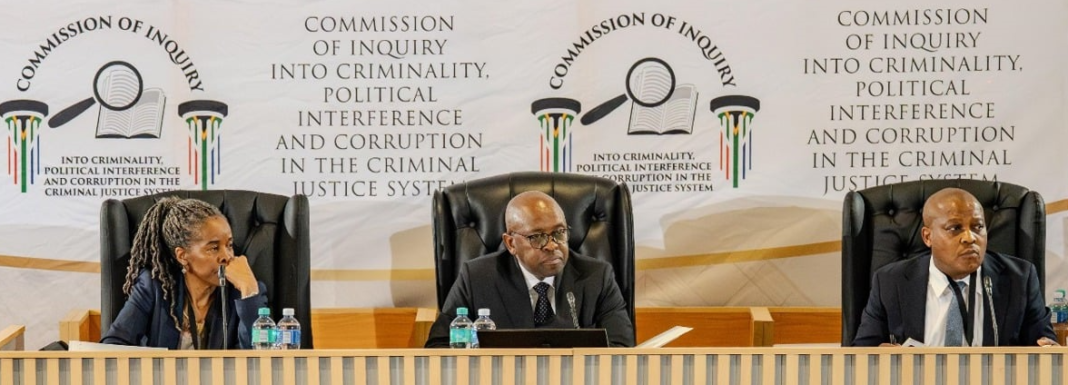
When plunder becomes a way of life for a group of men in a society, over the course of time, they create for themselves a legal system that authorises it and a moral code that glorifies it”On December 5, 2025, a former EMPD officer turned private security and recovery specialist named Marius Van Der Merwe was killed at Brakpan, Johannesburg. He was initially known as witness D while giving witness testimony in camera at the Madlanga Commission. Given the current state of South Africa and the brazen violation of the commission’s established modus operandi regarding in-camera witnesses such as Marius Van Der Merwe, this did not come as a surprise at all. Since July 6 press briefing at which Lieutenant General Nhlanhla Mkhwanazi highlighted the treasonous bromance between sitting politicians and criminal syndicates, it has become irrefutably clear that South Africa has indeed gone to the dogs. Regrettably, some Lesotho politicians passionately advocate that Lesotho be inducted into this orgy of shame. Triggered by the irrational and suspiciously rushed disbandment of the Political Killings Task Team (PKTT), Mkhwanazi brought to the attention of the already crime-weary South African public details too explosive to ignore.
Through a description of scenarios, specification of dates and mentioning of names, he demonstrated how the established link between sitting politicians and a specific criminal syndicate is just a tip of the rot discovered. Rather, the high point is that this syndicate is controlled by a drug cartel whose membership, besides politicians, includes high-ranking officials from the South African Police Service (SAPS), metro police and correctional services. To make matters worse, also involved are the people’s last line of defence against injustice – the prosecution and judiciary. But why must Lesotho hand its sovereignty to a country currently at the door of the deepest depths of hell? This is not just rot but an undeniable capture and collapse of the state by the underworld. True to its deceptive ways, the government quickly announced a hollow plan of action – the establishment of a commission of inquiry into these allegations. A now refinedtactic of the ANC is to either absolve criminally liable comrades or postpone criminal proceedings against them. This, in essence, is the real tragedy of the Madlanga Commission. To paraphrase Frédéric Bastiat’s words, it is nothing but a vehicle for further plunder authorised by the legal system overseen by a group of men (ANC) to whom plunder is second nature. What is more offensive about its existence is that its establishment highlights parliament’s neglect regarding its oversight mandate. How so?
Neglect, impotence or both?
It is now common knowledge that the epicentre of the allegations being investigated by the Madlanga Commission is the disbandment of the PKTT, a decision that was made on December 31, 2024. According to sections 55 and 199 of the Constitution of South Africa, the Parliament’s Portfolio Committee on Police has a twofold mandate: to ensure accountability and exercise oversight on both the SAPS and the executive. Two parliamentary processes used to execute this mandate are investigations and budget reviews. By admission of Ian Cameron in his capacity as Chair of the Portfolio Committee on Police, the disbandment of the PKTT came to his attention through a leaked notice. This he admitted in a podcast (SMWX) interview on November 6, 2025. In order to seek clarification on the matter, he claims to have enquired with the minister in early January. He further stated that Mkhwanazi did request and was twice granted invitations to the committee earlier last year (March 5 and April 2). This request came shortly after his mention, at the National Police Day celebration (January 27, 2025) in KwaZulu Natal, of a tug of war inside SAPS and that he and his team were prepared to fight back.
When asked why the committee did not urgently act on the allegations Mkhwanazi made in the meeting, his response painted a picture of wanton negligence. He stated that no mention was made of Cat Matlala or a drug cartel but only of Brown Mogotsi. On his first day at the commission, Mkhwanazi did indeed acknowledge attendance of these committee meetings. However, his explanation of the information he gave the committee about Mogotsi invalidates Cameron’s insinuation that what he said about Mogotsi was negligible. How could it be when he did not only provide evidence of Brown Mogotsi being an ordinary civilian with extraordinary access to confidential police information, the minister of police and high ranking police officials? Additionally and through evidence, he made the committee aware of a serious anomaly where officers in crime intelligence compromise state security by sharing classified information with civilians, including known Members of Parliament. This information alone was enough for the committee to seek accountability from the ministry and SAPS through a deeper investigation, but it never did. The outcome is not only a complete whitewash but a death trap for witnesses.
Endangering lives
It was only after the assassination of Witness D that the media began questioning the safety of witnesses; unfortunately asking the right questions at the wrong time. Two opportune moments at which such questions should have been asked were squandered. The first was on September 17 when the Minister of Justice and Constitutional Development (Mmamoloko Kubayi) broke down the R147.8 million allocated to the commission. R64 million is earmarked to pay the Commissioners, evidence leaders and legal researchers; R4.9 million for the support staff and R78.8 million to cover operational logistics. It was at that moment journalists should have demanded to know under which category witnesses were classified and exactly how much was specifically allocated to guarantee their safety. The second moment presented itself on the 15th day of the hearing (October 20) when the first in-camera testimony was given. Two working days earlier (October 13), the Chair had ruled that some evidence would be heard in camera. On the day the first of such witnesses (Witness A) testified, the evidence leader (Adv. Sello) began first by outlining the three categories of in camera evidence lined up for the commission.
She stated that in the first category, neither the witness nor the testimony will be revealed to the public. In the second category, the witness will not be seen, but in her (Adv. Sello’s) own words, she said in this particular instance, “their voices will probably be distorted.” The last category entailed witnesses who already reside in safe houses due to a determined level of danger facing them. As a result, they would not mind their voices being recognised. After this helpful explanation, Witness A proceeded to testify. However, his voice was not distorted, yet he did not reside in a safe house. It was based on this gross misstep that the media should have asked questions. That did not happen. As a result, three more witnesses (Witnesses B, C and D) who did not fall in the last category testified without voice distortion. This effectively turned their testimony into a dance with the devil; a Russian roulette in literal terms. Unfortunately, the last witness was killed. It was only thereafter that the media woke from its slumber. Even the Commissioners, who by virtue of not ensuring voice distortion are guilty of dereliction of duty, still mustered the audacity to visit the deceased’s house to pass their condolences – a real bastardisation of morality.
Operation whitewash
The primary goal of a judicial commission of inquiry is not to determine criminal liability. Rather, it is to inquire/investigate what went wrong and, thereafter, make non-binding recommendations as a remedy. South Africa’s post apartheid landscape is littered with examples of such unhelpful commissions. Some of the most prominent include: (a) The Seriti Commission of 2011 inquiring into allegations of fraud, corruption, impropriety or irregularity in the Strategic Defence Procurement Packages (Arms Deal); (b) The Marikana Commission of 2012 inquiring into tragic incidents at or near Marikana Mine in Rustenburg and; (c) The Zondo Commission of 2018 inquiring into allegations of state capture, corruption and fraud in the Public Sector including organs of State. Interestingly, the ANC used all these commissions to clear every other senior comrade with the exception of its black sheep – Jacob Zuma – as per the unprecedented private appeal of the outcome of the Seriti Commission of 2011. There is no doubt that if a moment presents itself, even the current commission is going to be used to clear criminally liable comrades, including Mchunu. A warning is how both the commissioners and the evidence leader watched as Mchunu’s lawyer underhandedly attempted a brazen clearance of his client. On a balance of probabilities, it is therefore a waste of hope to hope that the commission will be helpful. In this state of organised rot, what instead ought to have happened was for the police to execute arrests and for the NPA to criminally prosecute based on evidence already gathered by the PKTT and Gauteng’s Organised Crime Unit of SAPS. Anything else is a scam. Regrettably, Social Revolutionaries believe Lesotho deserves a place in this festival of destruction.
Summary
- When plunder becomes a way of life for a group of men in a society, over the course of time, they create for themselves a legal system that authorises it and a moral code that glorifies it” .
- Through a description of scenarios, specification of dates and mentioning of names, he demonstrated how the established link between sitting politicians and a specific criminal syndicate is just a tip of the rot discovered.
- It is now common knowledge that the epicentre of the allegations being investigated by the Madlanga Commission is the disbandment of the PKTT, a decision that was made on December 31, 2024.

Your Trusted Source for News and Insights in Lesotho!
At Newsday Media, we are passionate about delivering accurate, timely, and engaging news and multimedia content to our diverse audience. Founded with the vision of revolutionizing the media landscape in Lesotho, we have grown into a leading hybrid media company that blends traditional journalism with innovative digital platforms.