
When Tleetse Ada Phakoe talks about agriculture, she does not start with rainfall figures or policy documents. She starts with her mother.
“I experienced firsthand the impacts of climate change on the lands my widowed mother was working to provide for us,” she says. “Produce was no longer the same.”
That memory, more than any lecture hall, is where her life’s work began.
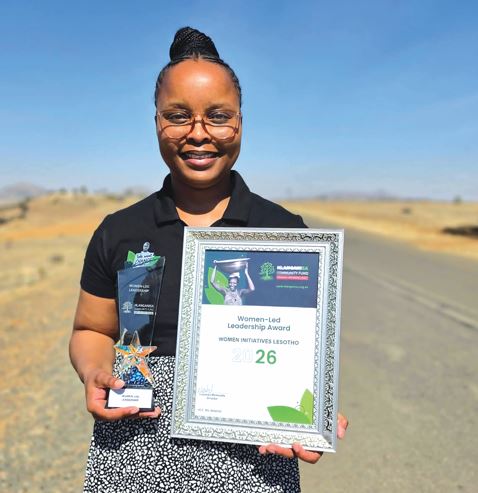
Today Phakoe is known across Mafeteng as an environmentalist, an eco-feminist and the founder of Women’s Initiative Lesotho (WIL), a women-led collective that has spent the past few years turning a hard truth about rural Lesotho, the people growing the country’s food are rarely the ones who control the land, the water or the decisions that shape their futures, into a programme of action.
It is a truth Phakoe has watched play out in her own home district. Mafeteng has long struggled with water shortages, while parts of the district face worsening land degradation. Droughts come more often than they used to. For a family like hers, that was not an abstract climate statistic, but it was the difference between a harvest and a bad year.
A rough start
Phakoe’s path to founding WIL was not a straight line. Like many young Basotho, she came home after finishing her studies to find no jobs waiting. The frustration of that period wore her down, and she says she fell into depression. What pulled her out was, in a way, the same thing that now defines her work, other women.
She began volunteering with a local women’s group and quickly noticed she was not the only one struggling. Young graduates ahead of her in age were still jobless. Others around her were being pulled into crime, early pregnancies, alcohol and drug use, or simply leaving the country to find work elsewhere.
“I started mobilising young women and youth, connecting them to opportunities and information,” she recalls.
That informal mobilising grew, slowly, into something bigger. WIL was established in 2022 and formally registered in 2024. It now describes its mission as advancing gender justice, climate justice and accountable governance, big words for what, on the ground, looks like community gardens, farmer training and tree planting.
Whose labour, whose land
According to Phakoe, roughly eight in every ten rural households in Lesotho depend on agriculture in some form. Women do much of that work. What they often do not have, Phakoe says, is land in their name, decent tools, or a say in how a household’s farming decisions get made.
“Women are already doing most of the labour-intensive work in Mafeteng’s food system,” she says. “Giving them land security, decision-making power and market access converts labour they’re already contributing into household nutrition and income they currently see very little of.”
That is the logic behind WIL’s approach, better seeds and drought-resistant crops will not fix much if the women doing the planting are still locked out of the decisions around them.
Young people are a smaller part of the picture. Phakoe estimates only about one in five farmers is young, and many who could take over family land choose to migrate instead, discouraged by how little farming seems to pay. WIL’s youth-focused work tries to change that impression, in part by bringing in tools like drone mapping and satellite imagery, which Phakoe uses herself as a trained GIS analyst and drone pilot, to help communities spot water-stressed land and plan irrigation more precisely.
“Young people are more likely to stay in a sector that looks like a skilled career, not a fallback,” she says.
What has actually been built
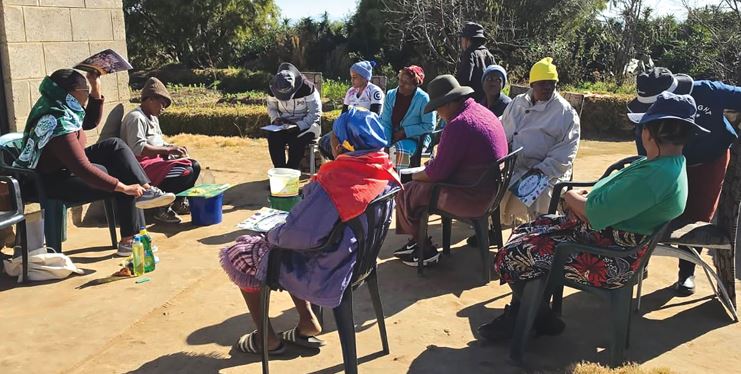
Numbers alone don’t capture what WIL does, but they give a sense of scale. Five community gardens established, two training manuals produced on organic pesticides and fertiliser, more than 1,000 farmers trained directly in agroecology, and over 5,000 reached through broader programmes. Volunteers and partner communities have planted more than 200,000 trees.
At Boleka, Ha-Maholi community garden, member Thakane Mphou says the project changed what her household could rely on, food for the table, and produce sold on to a local school for extra income.
Phakoe is wary of measuring success by attendance at a training session. “All of them have had the greatest impact and continue to do so since they are now in the hands of communities and we continue to provide support,” she says of WIL’s completed projects.
The limits of good intentions
WIL’s work has also taught Phakoe what doesn’t work, chiefly, plans drawn up far from the people meant to carry them out. Adaptation strategies designed in offices rarely survive contact with a village that has no reliable water source, she says. Training women in new farming methods means little if they still cannot own or control the land they farm.
It’s why WIL now tries to keep communities involved throughout a project, not just at the consultation stage. “We serve people by enhancing the decisions they make themselves,” Phakoe says.
The organisation’s next step is value addition, taking a crop or two already grown around Mafeteng and building simple processing, drying and packaging capacity so farmers keep more of what their produce is worth, rather than selling it raw for the smallest possible price. Phakoe sees this as opening doors for young people beyond the farm itself, into processing, marketing and small agribusiness.
Money, and the lack of it
Like most grassroots organisations, WIL runs on funding that rarely matches its ambitions. Phakoe points to donor dependency, small short-term grants and water scarcity as the obstacles that slow everything down. Small grants, she says, tend to force organisations into scattered, disconnected activities instead of building anything lasting.
Her ask of government is for genuine co-design, not just consultation after decisions are already made. Of development partners, she wants multi-year, flexible funding rather than one-off project money. Of the private sector, she wants help building markets for what farmers actually produce.
“WIL doesn’t need partners who write a check and step back,” she says. “We need partners willing to invest in a model we’re still proving.”
Starting before feeling ready
Phakoe’s own path into leadership began in 2020, when she joined a rural women’s movement years before WIL existed. It taught her, she says, that leadership doesn’t have to begin at the top, that credibility can be built inside communities that already exist, rather than from scratch.
Self-doubt, she admits, was one of her biggest obstacles. She wasn’t sure at first that she could build WIL or keep it funded. What got her through was learning that confidence tends to follow action, not the other way around.
“Success demands overcoming obstacles,” she says.
Since founding WIL, her own profile has grown alongside it. She holds a degree in Physical Geography from the National University of Lesotho (NUL), is completing a postgraduate diploma in Project Management, and has been named a 2025 Mandela Washington Fellow at Texas Tech University and a 2026 Queen Elizabeth Commonwealth Trust 100 Young Leaders Awardee.
But when she talks about the next ten years, the goal is not really about WIL’s name at all. She wants permanent infrastructure, more gardens with attached processing centres, a development hub for training and mentorship, run by the women who use them, so the next generation doesn’t have to start from nothing the way hers did.
“My work is dedicated to the people of Mafeteng as the ones on the frontlines against every form of injustice against them,” she says. “WIL is because of them.”
It is a modest way of describing an ambitious idea, that dignity in rural Lesotho starts with who gets to decide what happens to the land.
Summary
- Today Phakoe is known across Mafeteng as an environmentalist, an eco-feminist and the founder of Women’s Initiative Lesotho (WIL), a women-led collective that has spent the past few years turning a hard truth about rural Lesotho, the people growing the country’s food are rarely the ones who control the land, the water or the decisions that shape their futures, into a programme of action.
- For a family like hers, that was not an abstract climate statistic, but it was the difference between a harvest and a bad year.
- WIL’s youth-focused work tries to change that impression, in part by bringing in tools like drone mapping and satellite imagery, which Phakoe uses herself as a trained GIS analyst and drone pilot, to help communities spot water-stressed land and plan irrigation more precisely.

Senior journalist and communications professional with extensive experience in general news reporting, specializing in business and sports journalism. Skilled in public speaking, media relations, and strategic communication, with a proven ability to deliver accurate, engaging, and impactful stories.
A strong team player who thrives in collaborative environments and adapts effectively to diverse working conditions. Passionate about continuous learning, professional growth, and enhancing communication practices to meet evolving industry demands.