

Refiloe Molise
The Central Bank of Lesotho (CBL) is recalibrating its financial inclusion strategy, moving beyond simply ensuring access to banking services towards driving tangible economic impact, particularly among women-led businesses.
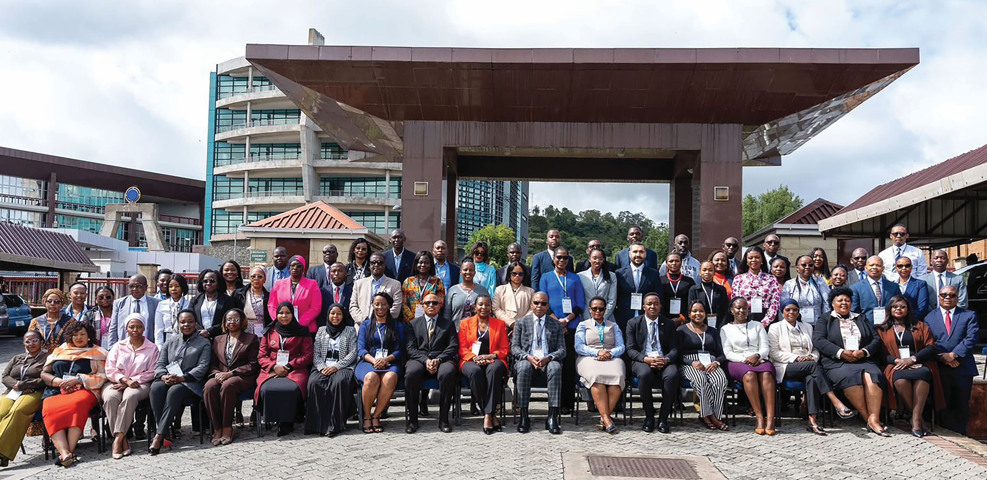
This shift was underscored during a Regional Joint Learning Programme on Alternative Finance Instruments for Women-led Micro, Small and Medium Enterprises (MSMEs), hosted by the CBL in partnership with the Alliance for Financial Inclusion (AFI) at Lehakoe Recreation and Cultural Centre in Maseru.
The high-level gathering attracted policymakers, regulators, financial institutions, development partners and women entrepreneurs from 23 African countries. The focus was on innovative financing solutions that not only expand access to financial services, but also ensure that women-led enterprises contribute meaningfully to economic growth and job creation.
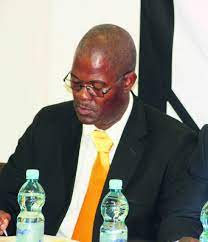
Speaking during the opening session, CBL’s Director of Financial Institutions Supervision, Bafokeng Noosi, said Lesotho was honoured to be recognised by AFI for its progress in advancing financial inclusion, particularly for women.
“We are very happy to host this joint learning programme. The joint learning programme is an opportunity or a platform for the country to showcase to the world and to the members of AFI the amount of work that we have done and the results that we have achieved,” Noosi said.
Lesotho joined AFI around 2014 and has since played an active role in shaping inclusive financial policies, particularly for small and vulnerable economies seeking equal representation on global platforms.
According to Noosi, the country has reached approximately 90 percent financial inclusion, largely driven by digital financial services and supportive regulatory reforms. However, he stressed that access alone is no longer enough.
“Financial inclusion is no longer about access now. It is about ensuring that women, youths and the marginalised are playing a critical role in the economy, that there are better outcomes than just one having a bank account,” he said.
Noosi emphasised that Lesotho’s progress has been a collaborative effort involving multiple stakeholders across the public and private sectors.
“The achievements that we have seen as a country is not that of the Central Bank alone, it is that of all the stakeholders that we have travelled this journey with,” he said.
On his part, AFI’s Chief Executive Officer, Dr Alfred Hannig, who addressed the gathering virtually, described alternative finance instruments as essential for Africa’s economic transformation, particularly in unlocking the potential of women entrepreneurs.
“Women entrepreneurs are critical to unlocking economic potential and advancing inclusive growth. Alternative finance instruments are not just technical add-ons. They are structural tools for economic transformation,” Dr Hannig said.
He noted that despite improved access to financial services, women entrepreneurs still face structural barriers such as limited collateral, lack of formal credit history and high financing costs.
He urged policymakers to adopt innovative solutions including credit guarantee schemes, marketplace lending and movable collateral-based lending to close the gender financing gap.
Also addressing the event, AFI’s Head of Policy Management, Audrey Hove, said the programme was significant not only for Lesotho but for governments across Africa and beyond.
“We are really excited to be here in Lesotho, particularly for this important event which is being hosted by the Central Bank. We are looking at having discussions among regulators and policymakers on alternative finance instruments to support women MSMEs,” he said.
She said representatives from 23 African countries had gathered to exchange ideas and practical solutions aimed at improving women’s access, usage and the quality of financial services.
“We are very delighted that the Central Bank of Lesotho has agreed to bring together these leaders to have these conversations. The reason why we chose Lesotho particularly is because of the tremendous work that we have seen that Lesotho has made in advancing women MSMEs in terms of their access as well as usage of financial services,” she said.
Hove added that peer learning remains one of AFI’s flagship services, enabling countries to share experiences and implement proven, scalable solutions.
“One flagship service that we offer at AFI is that we learn from each other. Everyone comes to the table with ideas and with what they have implemented. Together, if we have these conversations, we can implement from these,” she said.
She emphasised that inclusive economic strategies must place women at the centre.
“If we take along the women, who in many countries are the majority of the population, we have done our duty. We cannot talk about economic development, we cannot talk about economic growth, leaving women behind,” Hove said.
The programme drew participation from the Ministry of Finance, Ministry of Trade, Lesotho National Development Corporation (LNDC), Basotho Enterprises Development Corporation (BEDCO), commercial banks, microfinance institutions and women-led MSMEs, as well as development partners including the United Nations Development Programme (UNDP) and Deutsche Gesellschaft für Internationale Zusammenarbeit (GIZ).
Summary
- The joint learning programme is an opportunity or a platform for the country to showcase to the world and to the members of AFI the amount of work that we have done and the results that we have achieved,” Noosi said.
- “The achievements that we have seen as a country is not that of the Central Bank alone, it is that of all the stakeholders that we have travelled this journey with,” he said.
- The reason why we chose Lesotho particularly is because of the tremendous work that we have seen that Lesotho has made in advancing women MSMEs in terms of their access as well as usage of financial services,” she said.

Welcome to Newsday Media – Your Trusted Source for News and Insights in Lesotho!
At Newsday Media, we are passionate about delivering accurate, timely, and engaging news and multimedia content to our diverse audience. Founded with the vision of revolutionizing the media landscape in Lesotho, we have grown into a leading hybrid media company that blends traditional journalism with innovative digital platforms.
Our mission is simple: to inform, inspire, and empower our readers by providing comprehensive coverage of local and global events, current affairs, and cultural happenings. Whether you’re looking for breaking news, in-depth analysis, or captivating storytelling, Newsday Media is your go-to destination for all things news-related.
With a dedicated team of journalists, editors, and multimedia experts, we are committed to upholding the highest standards of journalistic integrity and professionalism. We pride ourselves on delivering content that not only informs but also sparks conversation, fosters understanding, and drives positive change in our society.
From our flagship newspaper to our dynamic digital platforms, we offer a wide range of multimedia content to cater to the diverse interests and preferences of our audience. Whether you prefer to stay informed through print, online articles, videos, or podcasts, Newsday Media has something for everyone.
We believe in the power of storytelling to connect people, bridge divides, and inspire action. That’s why we’re dedicated to providing a platform for voices from all walks of life, championing diversity, inclusion, and authenticity in everything we do.
Thank you for visiting Newsday Media. We invite you to explore our website, engage with our content, and join us on our journey to inform, inspire, and empower our community. Together, let’s shape the future of media in Lesotho.