Seabata Mahao is a general news reporter with special focus on Business and Sports. Started working at Newsday in 2021. Working in a team with a shared goal is what I enjoy most and that gives me the motivation to work under any environment leading to growth.
The Central Bank of Lesotho (CBL) has warned that growing global uncertainty, weakening economic conditions and rising domestic vulnerabilities are increasing risks to the country’s financial system, urging stronger vigilance from regulators, businesses and households.
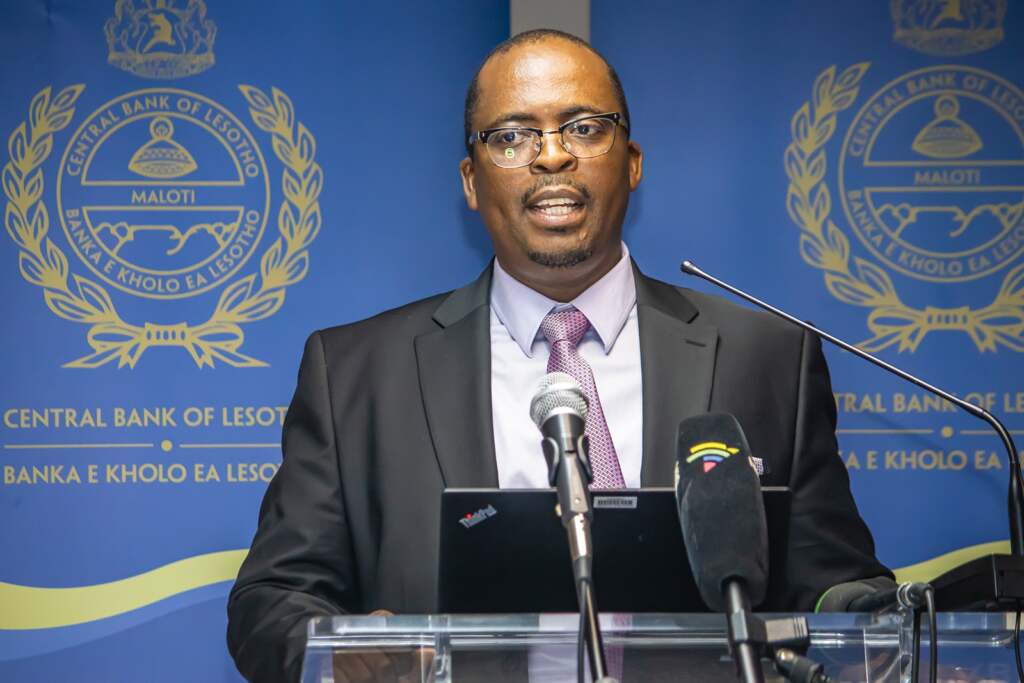
The warning emerged during the launch of the CBL’s tenth Financial Stability Report (FSR) in Maseru, where Governor Dr Maluke Letete said Lesotho faces mounting financial pressures stemming from geopolitical conflicts, volatile global markets and slowing economic activity.
Letete said the report comes at a critical time marked by heightened global uncertainty, persistent geopolitical tensions and deteriorating macro-financial conditions.
He warned that ongoing conflicts, including tensions involving the United States and the Russia–Ukraine war, continue to fragment global trade systems, destabilise commodity markets and increase policy uncertainty across economies.
“For small open economies such as Lesotho, these global developments affect the country through trade, commodity prices, financial flows and confidence channels, increasing domestic risks and limiting policy space,” he said.
According to the report, financial stability risks intensified during 2025 as households, businesses and the public sector came under growing strain amid slowing economic activity and declining external support.
Letete said household credit continued to expand despite fragile labour-market conditions, contributing to rising non-performing loans, particularly in mortgage and unsecured personal lending.
“In the business sector, declining export demand, falling diamond prices and heightened global trade uncertainty weakened cash flows and debt-servicing capacity, resulting in increased credit risk across industries,” he added.
The report further cautioned that although fiscal outcomes remained favourable on the surface, Lesotho’s public finances remain vulnerable because of continued dependence on volatile external revenues, particularly receipts from the Southern African Customs Union (SACU), coupled with a rigid expenditure structure dominated by the public-sector wage bill.
Head of the Financial Stability Department at the CBL, Nkhahle Seeiso, said vulnerabilities within the non-bank financial sector are also contributing to elevated systemic risks.
Although the insurance and microfinance sectors recorded growth and improved profitability, Seeiso warned that balance-sheet weaknesses remain a concern.
He said the insurance industry continues to face challenges linked to high operating costs, market concentration and uneven reinsurance utilisation. Meanwhile, the microfinance sector remains exposed to liquidity and credit risks because of loan-concentrated asset structures and reliance on borrowed funding.
Despite the growing risks, Seeiso said Lesotho’s financial system remains broadly resilient.
“The banking sector continues to maintain strong capitalisation, high liquidity buffers and positive profitability despite some deterioration in asset quality during the year,” he said.
He added that stress-testing results showed banks remain well positioned to withstand macro-financial shocks, with capital levels staying above regulatory requirements under different stress scenarios.
Seeiso further noted that key financial market infrastructures, including the Lesotho Wire and Automated Clearing House systems, continued to operate efficiently and support smooth payment and settlement processes.
At the same time, he cautioned that the rapid growth of mobile-money services, while improving financial inclusion, has also increased exposure to operational, liquidity and cybersecurity risks that require close regulatory oversight.
The report also highlighted the continued decline in global diamond prices and its impact on Lesotho’s broader economic outlook.
According to the analysis, prolonged weakness in the diamond sector has reduced export earnings, weakened government revenues and heightened credit risks as businesses struggle and job losses increase.
In response to the emerging threats, Seeiso said the CBL will continue strengthening macro-prudential surveillance, enhancing early warning systems and tightening oversight mechanisms to ensure risks are identified and addressed promptly.
International Monetary Fund representative Andrew Steven said geopolitical developments continue to play a major role in shaping global macroeconomic conditions.
Steven explained that escalating trade wars, military conflicts and political instability disrupt trade flows, alter investment patterns and influence economic policies across interconnected economies.
CBL Deputy Governor Lehlomela Mohapi echoed those concerns, stressing that global transmission channels increasingly influence domestic prices and economic conditions in Lesotho.
Mohapi said Lesotho’s heavy dependence on imports, particularly from South Africa, leaves the country highly exposed to global market shocks and supply chain disruptions.
He explained that geopolitical conflicts such as the Russia–Ukraine war continue to affect fuel prices and transport costs, ultimately raising production costs across sectors.
“These shocks eventually filter down to everyday life,” Mohapi said, warning that rising diesel prices are already increasing farming costs and are likely to push up food prices, particularly maize meal, in the coming months.
He added that ordinary Basotho travelling long distances between districts such as Mokhotlong and Maseru are already feeling the burden of rising transport and living costs.
Mohapi also urged households to adopt more resilient financial strategies, warning against dependence on a single source of income or investment.
“People should not invest all their money in one place. It is important to diversify income sources so that when shocks occur, households are not left completely exposed,” he said.
He further called for stronger collaboration among regulators, financial institutions, government and the private sector to preserve financial stability amid growing uncertainty.
Meanwhile, ‘Mamotlohi Mochebelele raised concerns about the impact of geopolitical instability on pension investments.
Mochebelele explained that pension funds rely on long-term investment strategies in which monthly contributions from civil servants are invested across financial markets to generate future retirement benefits.
However, she warned that prolonged global instability and market volatility threaten investment returns and could negatively affect pension payouts if economic pressures persist over an extended period.
“We collect money every month from civil servants and invest it so that when they retire, they can receive their pensions,” she said.
She cautioned that sustained geopolitical shocks could erode the long-term value of pension assets, placing future retirees at greater financial risk.
Summary
The Central Bank of Lesotho (CBL) has warned that growing global uncertainty, weakening economic conditions and rising domestic vulnerabilities are increasing risks to the country’s financial system, urging stronger vigilance from regulators, businesses and households.
The warning emerged during the launch of the CBL’s tenth Financial Stability Report (FSR) in Maseru, where Governor Dr Maluke Letete said Lesotho faces mounting financial pressures stemming from geopolitical conflicts, volatile global markets and slowing economic activity.
The report further cautioned that although fiscal outcomes remained favourable on the surface, Lesotho’s public finances remain vulnerable because of continued dependence on volatile external revenues, particularly receipts from the Southern African Customs Union (SACU), coupled with a rigid expenditure structure dominated by the public-sector wage bill.
Seabata Mahao is a general news reporter with special focus on Business and Sports. Started working at Newsday in 2021. Working in a team with a shared goal is what I enjoy most and that gives me the motivation to work under any environment leading to growth.
To ensure optimal experiences, we utilize technologies such as cookies to store and/or access information from your device. Granting consent to these technologies enables us to process data, including browsing habits or unique identifiers on this website. Conversely, not consenting or revoking consent may negatively impact specific features and functionalities.
Functional
Always active
The technical storage or access is strictly necessary for the legitimate purpose of enabling the use of a specific service explicitly requested by the subscriber or user, or for the sole purpose of carrying out the transmission of a communication over an electronic communications network.
Preferences
The technical storage or access is necessary for the legitimate purpose of storing preferences that are not requested by the subscriber or user.
Statistics
The technical storage or access that is used exclusively for statistical purposes.The technical storage or access that is used exclusively for anonymous statistical purposes. Without a subpoena, voluntary compliance on the part of your Internet Service Provider, or additional records from a third party, information stored or retrieved for this purpose alone cannot usually be used to identify you.
Marketing
The technical storage or access is required to create user profiles to send advertising, or to track the user on a website or across several websites for similar marketing purposes.