

by Ntsoaki Motaung and Thoboloko Ntšonyane
Barely two years after it was handed over as one of Lesotho’s most modern public health facilities, Maseru District Hospital is operating without a functional incinerator, forcing hazardous medical waste to accumulate on its premises and exposing patients, staff and nearby communities to potential health and environmental risks.
The situation has raised questions about how a newly constructed hospital could begin operations without a functioning waste disposal system, despite generating large volumes of infectious medical waste every day.
Maseru District Hospital is a modern public hospital. It opened on June 13, 2024, as the country’s second major referral hospital, alongside Queen ‘Mamohato Memorial Hospital QMMH.
It was primarily built to relieve overcrowding and pressure on QMMH. It is designed to serve around 400,000 patients from Maseru and surrounding districts. It has 200 beds and functions as a district and referral hospital offering specialised care.
Construction began around April 2021. It was funded by the Chinese government (approximately CN¥400–430 million grant) as part of the Belt and Road Initiative and built by the Shanghai Construction Group.
The World Health Organization (WHO) provided technical support.
It is sometimes referred to in connection with an associated Eye Clinic and features modern facilities, including specialist departments in infectious diseases, dermatology, ophthalmology, an intensive care unit (ICU), and a histopathology lab.
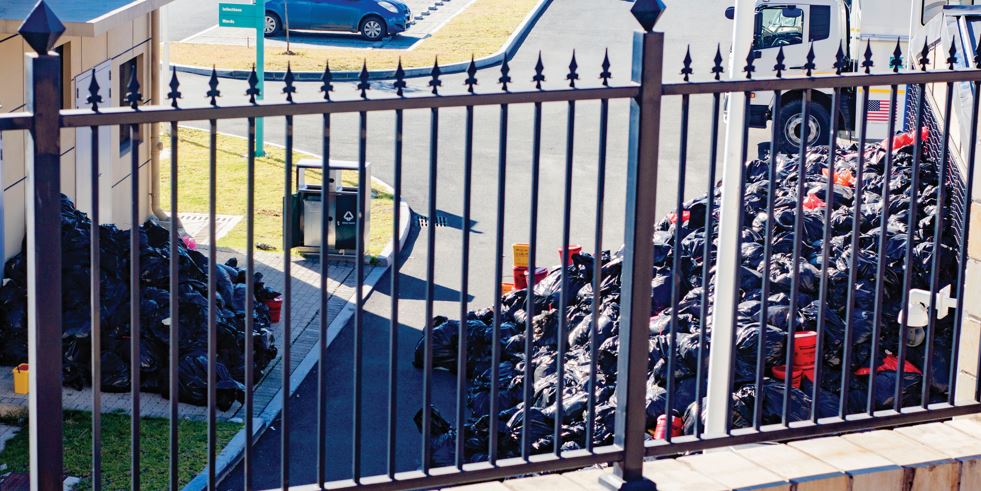
Now, behind the hospital’s mortuary, piles of used bandages, syringes, needles, placentas and other infectious waste continue to grow as the hospital struggles to dispose of them.
The problem came into sharp focus in early May when Parliament’s Social Cluster Portfolio Committee visited the facility.
Committee chairperson Mokhothu Makhalanyane said Members of Parliament (MPs) found the designated medical waste storage area overflowing.
“The area where medical waste is kept is very full and some of it is spilling out of the storage,” Makhalanyane said. “There is a foul smell, and I foresee that if action is not taken, we will have rats. There are already insects, and soon there will be worms.”
The committee found waste spilling out of storage areas, with torn refuse bags exposing infectious materials while pools of unidentified fluids had seeped onto the ground.
Sources within the hospital say the incinerator has never worked since the facility was handed over to the Government of Lesotho by the People’s Republic of China in June 2024.
As a result, waste that should ordinarily be destroyed on-site has had to be transported to other health facilities with working incinerators.
For a time, Newsday has learned, a porter volunteered to transport waste to Scott Hospital for disposal, hoping the hospital management would recognise the effort and assign the duty formally. But when it became clear that no one cared, even that small act of initiative died.
Since then, the waste has simply been left to pile up.
Hospital sources say the breakdown has also affected compliance with infection prevention protocols.
Medical waste that should be separated into colour-coded biohazard containers is now frequently disposed of in ordinary black refuse bags.
“It means protocols are not followed and everyone’s health is at risk,” one source said.
The source warned that the situation increases the risk of hospital-acquired infections while also exposing cleaners, waste handlers and the public to potentially infectious materials.
Environmental concerns are also mounting.
According to hospital sources, flies breed around the waste while rainwater carries contaminated runoff into the surrounding soil, raising fears of land.
“The situation affects not only people but also the environment because both the land and the air become polluted,” another source said.
Hospital spokesperson Kekeletso Motanyane acknowledged that the hospital has no functioning incinerator.
Motanyane said medical waste is temporarily stored before being collected by the Project Implementing Unit (PIU) and transported to hospitals with operational incinerators.
According to Motanyane, collections can take place up to three times a day but delays by the PIU sometimes leave waste accumulating beyond the storage area’s capacity.
She referred questions about repairing or replacing the incinerator to the Ministry of Health.
However, the ministry’s spokesperson, ‘Mateboho Mosebekoa, did not explain why the hospital has continued operating without a functional incinerator, instead indicating that a health inspector would respond.
Meanwhile, the hospital continues generating hazardous waste around the clock as its operating theatres remain fully functional.
Some of the most hazardous waste, including placentas and amputated body parts, must be transported to hospitals as far away as Roma and Quthing for destruction.
Motanyane said the hospital has introduced interim measures, including improved waste segregation, tighter storage controls and continuous monitoring while working with the Ministry of Health to find a permanent solution.
Despite those measures, the growing waste pile has become a visible reminder of a fundamental infrastructure gap at one of the country’s newest hospitals.
For a facility built to represent a modern healthcare system, the absence of a functioning incinerator has exposed a critical weakness in its design, commissioning or maintenance, one that now threatens public health and the environment alike.
Summary
- Barely two years after it was handed over as one of Lesotho’s most modern public health facilities, Maseru District Hospital is operating without a functional incinerator, forcing hazardous medical waste to accumulate on its premises and exposing patients, staff and nearby communities to potential health and environmental risks.
- It is sometimes referred to in connection with an associated Eye Clinic and features modern facilities, including specialist departments in infectious diseases, dermatology, ophthalmology, an intensive care unit (ICU), and a histopathology lab.
- For a time, Newsday has learned, a porter volunteered to transport waste to Scott Hospital for disposal, hoping the hospital management would recognise the effort and assign the duty formally.

Welcome to Newsday Media – Your Trusted Source for News and Insights in Lesotho!
At Newsday Media, we are passionate about delivering accurate, timely, and engaging news and multimedia content to our diverse audience. Founded with the vision of revolutionizing the media landscape in Lesotho, we have grown into a leading hybrid media company that blends traditional journalism with innovative digital platforms.
Our mission is simple: to inform, inspire, and empower our readers by providing comprehensive coverage of local and global events, current affairs, and cultural happenings. Whether you’re looking for breaking news, in-depth analysis, or captivating storytelling, Newsday Media is your go-to destination for all things news-related.
With a dedicated team of journalists, editors, and multimedia experts, we are committed to upholding the highest standards of journalistic integrity and professionalism. We pride ourselves on delivering content that not only informs but also sparks conversation, fosters understanding, and drives positive change in our society.
From our flagship newspaper to our dynamic digital platforms, we offer a wide range of multimedia content to cater to the diverse interests and preferences of our audience. Whether you prefer to stay informed through print, online articles, videos, or podcasts, Newsday Media has something for everyone.
We believe in the power of storytelling to connect people, bridge divides, and inspire action. That’s why we’re dedicated to providing a platform for voices from all walks of life, championing diversity, inclusion, and authenticity in everything we do.
Thank you for visiting Newsday Media. We invite you to explore our website, engage with our content, and join us on our journey to inform, inspire, and empower our community. Together, let’s shape the future of media in Lesotho.