
Lesotho’s drive to build a digitally competitive economy gained momentum this week as Econet Telecom Lesotho (ETL) and the United Nations Development Programme (UNDP) renewed their partnership to advance artificial intelligence, digital infrastructure and innovation.
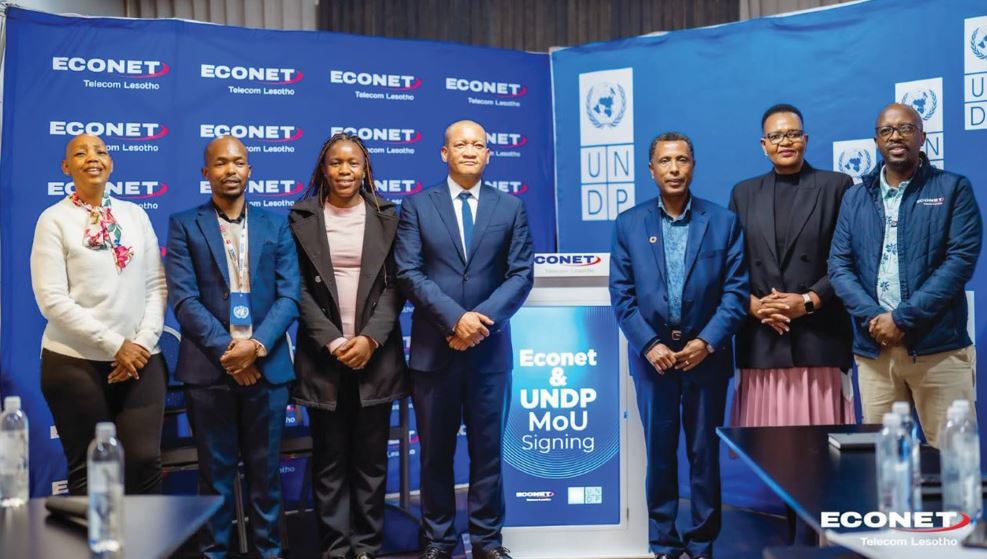
The agreement, signed by ETL Chief Executive Officer Dennis Plaatjies and UNDP Deputy Resident Representative Dr Taye Amssalu, extends a collaboration that began in 2020 and expanded in 2022.
Unlike previous arrangements, which focused primarily on digital inclusion, the renewed partnership signals a shift towards positioning Lesotho within the global AI economy.
The digital economy offers one of the few realistic pathways Lesotho to diversify its economy, which has traditionally depended on textiles, remittances, water exports and customs revenue
But the question is whether the country has the infrastructure, policy environment and human capital required to participate meaningfully in that future.
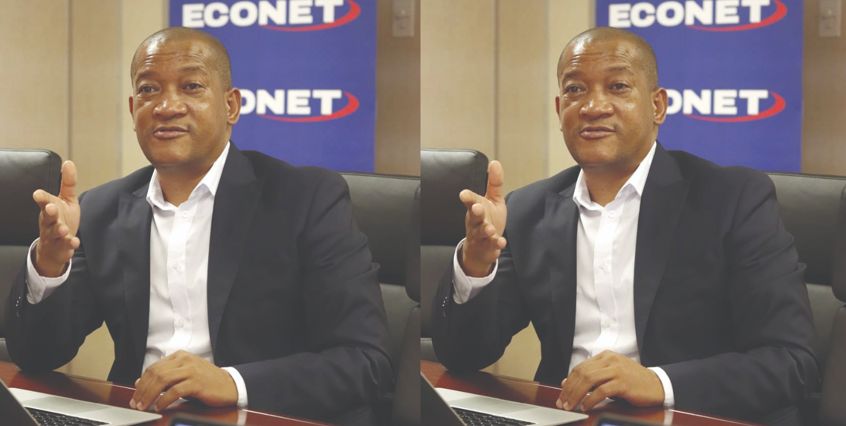
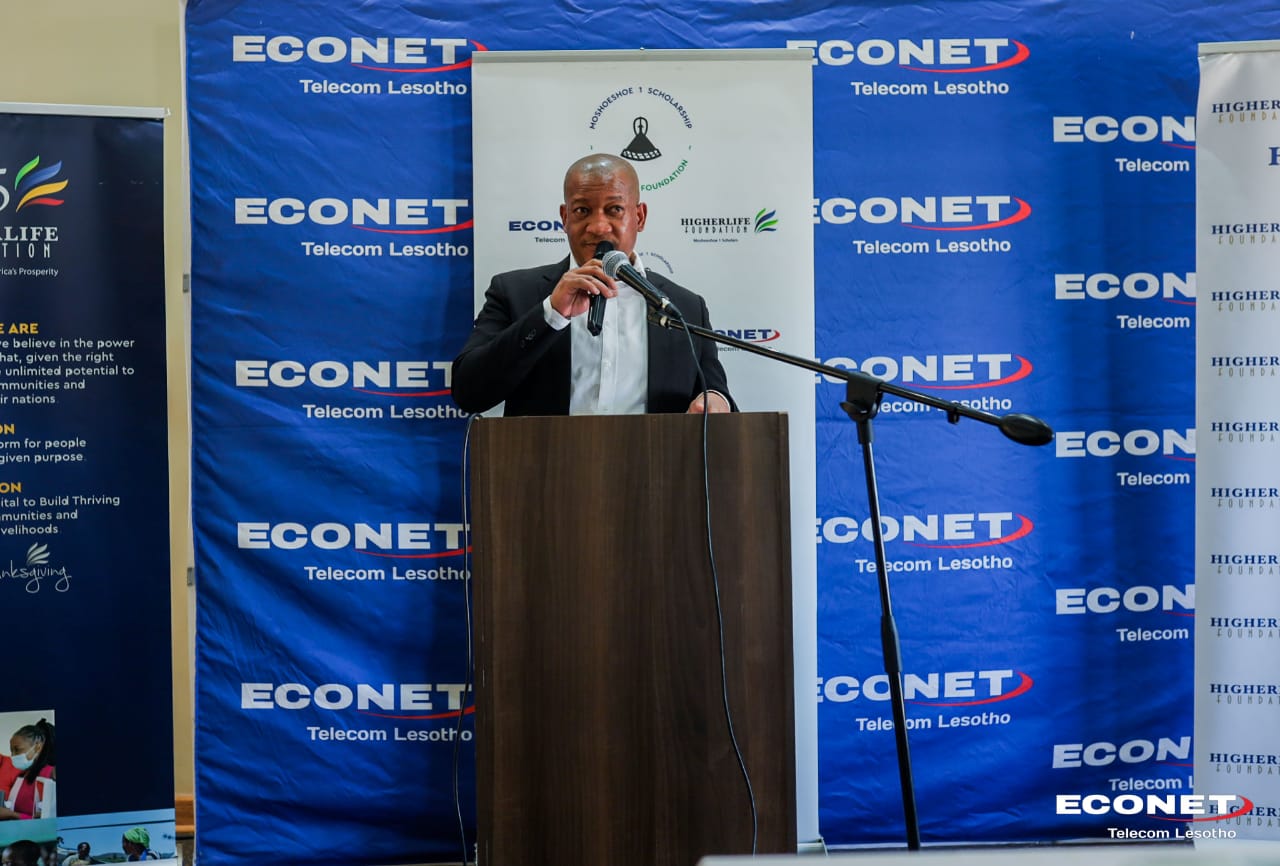
Addressing stakeholders at the signing ceremony, Plaatjies argued that telecommunications companies can no longer define themselves simply as providers of connectivity.
“Connectivity is no longer simply about communication. It is a foundation for innovation, economic growth and inclusive development,” he said.
Plaatjies revealed that ETL has spent the past several years modernising its network to support advanced technologies such as AI and cloud computing, investments he said place Lesotho in a stronger position than many African countries found themselves in during previous waves of technological change.
For decades, Africa lagged behind in adopting transformative technologies. Electricity took more than half a century to become widespread after its introduction elsewhere; fixed-line telecommunications followed decades later, and internet adoption trailed by more than a decade. According to Plaatjies, AI presents an opportunity to break that historical pattern.
“With AI, we are ready from year zero because of the investments ETL has already made,” he said.
Plaatjies disclosed that the broader ETL Group has secured access to AI computing capacity through a partnership with global chipmaker NVIDIA, while ETL itself has developed sovereign cloud and data infrastructure capable of hosting local datasets and AI applications within the country. For policymakers increasingly concerned about data sovereignty and digital independence, locally hosted cloud infrastructure could become an important strategic asset.
Yet Plaatjies was equally clear that infrastructure alone would not deliver digital transformation.
“We recognise that infrastructure is not enough. What matters equally is building the right policy environment and investing in people who will create, manage and innovate with these technologies.”
Among the partnership’s flagship initiatives are plans to establish a National AI Academy, expand the University Innovation Pod (UNIPOD), promote research collaborations and strengthen entrepreneurship programmes targeting young innovators.
If successfully implemented, these initiatives could help narrow the country’s growing digital skills gap while building an innovation pipeline capable of supporting technology startups and knowledge-based industries.
Perhaps the most notable aspect of the agreement is its attempt to move AI beyond theoretical discussion into practical economic application. Rather than treating AI solely as an emerging technology, the partnership identifies sectors where intelligent systems could improve productivity and service delivery, including healthcare, agriculture, education and government.
Plaatjies indicated that ETL will soon introduce locally relevant AI-powered solutions developed specifically for African markets. Such technologies could improve diagnostic services in healthcare, strengthen agricultural extension services, enhance public administration and support small businesses through automation and digital financial services.
According to the UNDP, the partnership aligns with its broader objective of using digital technologies to accelerate progress towards the Sustainable Development Goals. Dr Taye Amssalu described digital transformation as one of the most powerful drivers of inclusive development.
“Through this strengthened partnership with ETL, we aim to support Lesotho in building inclusive digital ecosystems that create jobs, strengthen institutions, improve public service delivery and ensure that no one is left behind in the digital age,” he said.
The agreement also commits both organisations to supporting Lesotho’s emerging Artificial Intelligence policy framework, while promoting ethical, secure and responsible AI adoption. That policy dimension may ultimately prove just as important as the technology itself.
Around the world, governments are grappling with questions of AI governance, privacy, algorithmic bias and cybersecurity. Developing clear regulations early could improve investor confidence while protecting citizens as AI becomes increasingly embedded in public services and private enterprise.
Rather than relying solely on donor-funded programmes, governments and development agencies are increasingly leveraging private sector investment to achieve national development objectives.
In this case, UNDP contributes policy expertise, institutional support and international development experience, while ETL provides commercial infrastructure, technology investment and implementation capacity.
Summary
- Plaatjies revealed that ETL has spent the past several years modernising its network to support advanced technologies such as AI and cloud computing, investments he said place Lesotho in a stronger position than many African countries found themselves in during previous waves of technological change.
- Plaatjies disclosed that the broader ETL Group has secured access to AI computing capacity through a partnership with global chipmaker NVIDIA, while ETL itself has developed sovereign cloud and data infrastructure capable of hosting local datasets and AI applications within the country.
- “Through this strengthened partnership with ETL, we aim to support Lesotho in building inclusive digital ecosystems that create jobs, strengthen institutions, improve public service delivery and ensure that no one is left behind in the digital age,” he said.

Senior journalist and communications professional with extensive experience in general news reporting, specializing in business and sports journalism. Skilled in public speaking, media relations, and strategic communication, with a proven ability to deliver accurate, engaging, and impactful stories.
A strong team player who thrives in collaborative environments and adapts effectively to diverse working conditions. Passionate about continuous learning, professional growth, and enhancing communication practices to meet evolving industry demands.