

Nicole Tau
Maseru, Lesotho – In a room filled with diplomats, policymakers, grassroots advocates, and survivors, a decade-long national conversation about violence confronted its most decisive moment. The official launch of the Lesotho Gender-Based Violence Indicators Follow-Up Study delivered a complex, paradoxical truth: while lifetime gender-based violence (GBV) against women has plummeted over the past 12 years, deep institutional gaps and intergenerational trauma continue to hold the nation in a vice grip.
According to the new nationwide study, conducted by Gender Links in partnership with the Bureau of Statistics and supported by the European Union, lifetime GBV prevalence among Basotho women fell from 86% in 2013 to 66.7% in 2025, while lifetime intimate partner violence (IPV) dropped from 62% to 45.7%. Most notably, past-year intimate partner violence nearly halved, falling from 28% to 14.8%.
Yet, behind these encouraging top-line figures lies an alarming reality of justice denied: nine out of ten women who experience intimate partner violence never report it to the police. Fewer than 16% of perpetrators are ever arrested, and under 2% face legal consequences.
A Conversation with Honesty in Abundance
Delivering the keynote address on behalf of the Ministry of Gender, Youth, Sports, Arts, Culture, and Social Development, Principal Secretary Mahlapane Makakole Bodiba captured the gravity of the room.
“I stand before you today to share a conversation that our country has been having with itself for more than a decade. A conversation about violence that happens behind closed doors, in our workplaces, in our schools, office retreats, and increases in the digital spaces,” Bodiba stated. “Today’s report provides that conversation with honesty in abundance.”
Reflecting on the 2013 baseline findings, Bodiba noted that past statistics served not as a permanent mark of shame, but as an imperative for reform.
“Ladies and gentlemen, 12 years ago, the first gender-based violence indicator study confronted with the uncomfortable truth that 86% of women had experienced some kind of GBV at one point or another, and 40% of men had perpetrated violence against women,” she said. “Those figures are not the condemnation of the restricted people. They are a call for action.”
The progress achieved since then represents thousands of women who are measurably safer today. However, the study laid bare systemic bottlenecks that continue to leave survivors isolated. Beyond the abysmal conviction rates, shelter services remain severely restricted, existing almost exclusively in Maseru, leaving survivors across the rest of the country with virtually no safe refuge. Furthermore, 65% of female survivors meet the clinical threshold for depression, in a country with just 0.05 psychiatrists per 100,000 people.
The room fell silent as Bodiba addressed the study’s most sobering revelation: 80% of Basotho adults carry Adverse Childhood Experiences (ACEs), with physical abuse before age 15 reported by 63.6% of men and 68.7% of women.
She added a personal note to the statistic.
“And physical abuse before the age of 15 is reported by 63.6% of men and 68.7% for women… And I can attest to that because I am one of such victims.”
That moment mattered.
Behind the percentages, graphs and policy recommendations are people whose experiences of violence often begin long before they become adults, and whose trauma can continue to shape relationships, mental health and communities.
Moving From Isolated Efforts to Coordinated Action
This shift from statistical reflection to human accountability resonated throughout the proceedings. European Union Ambassador to Lesotho, Her Excellency Mette Sunnergren, emphasized that data must serve as a catalyst for immediate, unified structural reform.
“I would really like to begin to move from concern to action, from policy commitments to implementation and from isolated interventions to a more coordinated national response,” Ambassador Sunnergren urged.
Highlighting the European Union’s ongoing funding commitment of nearly €8.5 million (approximately M168 million) toward human rights, youth, and protection initiatives in Lesotho, Sunnergren underscored the vital connection between equal justice and societal stability.
“This is why equal access to justice matters so profoundly. It is essential for protecting women and girls and for accountable governance, public trust, social cohesion,” Sunnergren added. “We also know that prevention, protection, prosecution and survivor support must go hand in hand.”
Speaking on behalf of the Bureau of Statistics (BOS), Senior Statistician Lehlohonolo Takalimane reinforced that rigorous data gathering is essential for informing operational policy.
“GBV remains a major concern, requiring evidence-based and coordinated action in the country,” Takalimane noted. “We encourage all stakeholders to engage with the findings and, most importantly, to translate the evidence into concrete actions.”
Breaking New Ground: Digital Abuse, Attitudes, and Marginalized Voices
The 2025 follow-up study broke significant new methodological ground by assessing previously unmeasured dimensions of abuse, including technology-facilitated GBV (TFGBV), disability, and violence against LGBTIQ+ individuals.
The study highlighted a monumental cultural shift: agreement with the assertion that “a woman should obey her husband” dropped from 97% among women and 96% among men in 2013 to 33.9% and 49.2% respectively.
However, new risks have emerged. Approximately one in five internet users in Lesotho experiences technology-facilitated GBV, driven primarily by online harassment and unwanted messaging. Furthermore, data drawn from the accompanying policy brief revealed that 50% of transgender respondents experienced GBV in the past year, more than double the rate of women in the general population, with 93.8% of those attacks directly linked to their gender identity. Despite this, Zero Tolerance to Violence Against Children and Gender Protection Unit (CGPU) offices currently operate with SOGIE-inclusive standard operating procedures.
From Evidence to Ownership
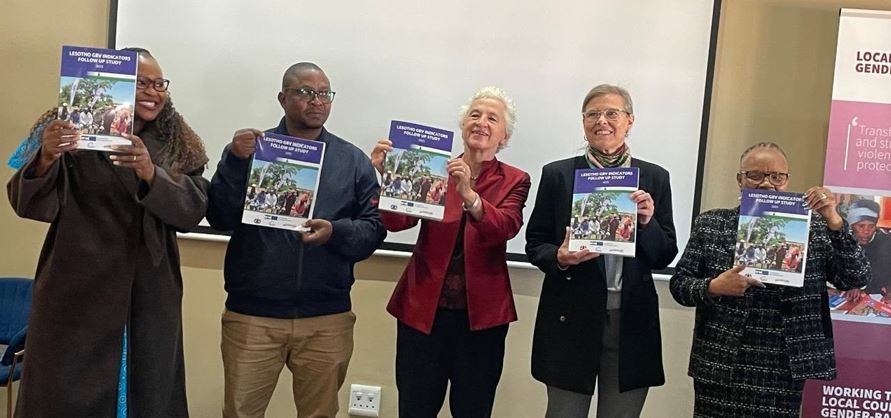
As the official launch concluded with leaders raising copy volumes of the report in place of glasses, the central mandate of the gathering remained clear: data alone will not protect a survivor, nor will policy commitments without budget allocation to heal a traumatized generation.
In response, the Ministry of Gender pledged concrete institutional commitments, including dedicated funding for the Anti-GBV Forum coordination body, parliamentary tracking mechanisms for public accountability, and integrating childhood trauma screening into primary healthcare.
“No institution can end gender-based violence alone. We are gathered here today to see to it that we are going to take action,” Bodiba concluded. “To the 4,254 women and men who shared their most painful experiences, so that the rest of us might understand, we really thank you all and this report belongs to you.”
The true legacy of the 2025 study will not be recorded in the volumes distributed today, but in whether government, law enforcement, and civil society turn these painful truths into lasting protection.
Summary
- Delivering the keynote address on behalf of the Ministry of Gender, Youth, Sports, Arts, Culture, and Social Development, Principal Secretary Mahlapane Makakole Bodiba captured the gravity of the room.
- “Ladies and gentlemen, 12 years ago, the first gender-based violence indicator study confronted with the uncomfortable truth that 86% of women had experienced some kind of GBV at one point or another, and 40% of men had perpetrated violence against women,” she said.
- “I would really like to begin to move from concern to action, from policy commitments to implementation and from isolated interventions to a more coordinated national response,” Ambassador Sunnergren urged.

Welcome to Newsday Media – Your Trusted Source for News and Insights in Lesotho!
At Newsday Media, we are passionate about delivering accurate, timely, and engaging news and multimedia content to our diverse audience. Founded with the vision of revolutionizing the media landscape in Lesotho, we have grown into a leading hybrid media company that blends traditional journalism with innovative digital platforms.
Our mission is simple: to inform, inspire, and empower our readers by providing comprehensive coverage of local and global events, current affairs, and cultural happenings. Whether you’re looking for breaking news, in-depth analysis, or captivating storytelling, Newsday Media is your go-to destination for all things news-related.
With a dedicated team of journalists, editors, and multimedia experts, we are committed to upholding the highest standards of journalistic integrity and professionalism. We pride ourselves on delivering content that not only informs but also sparks conversation, fosters understanding, and drives positive change in our society.
From our flagship newspaper to our dynamic digital platforms, we offer a wide range of multimedia content to cater to the diverse interests and preferences of our audience. Whether you prefer to stay informed through print, online articles, videos, or podcasts, Newsday Media has something for everyone.
We believe in the power of storytelling to connect people, bridge divides, and inspire action. That’s why we’re dedicated to providing a platform for voices from all walks of life, championing diversity, inclusion, and authenticity in everything we do.
Thank you for visiting Newsday Media. We invite you to explore our website, engage with our content, and join us on our journey to inform, inspire, and empower our community. Together, let’s shape the future of media in Lesotho.