

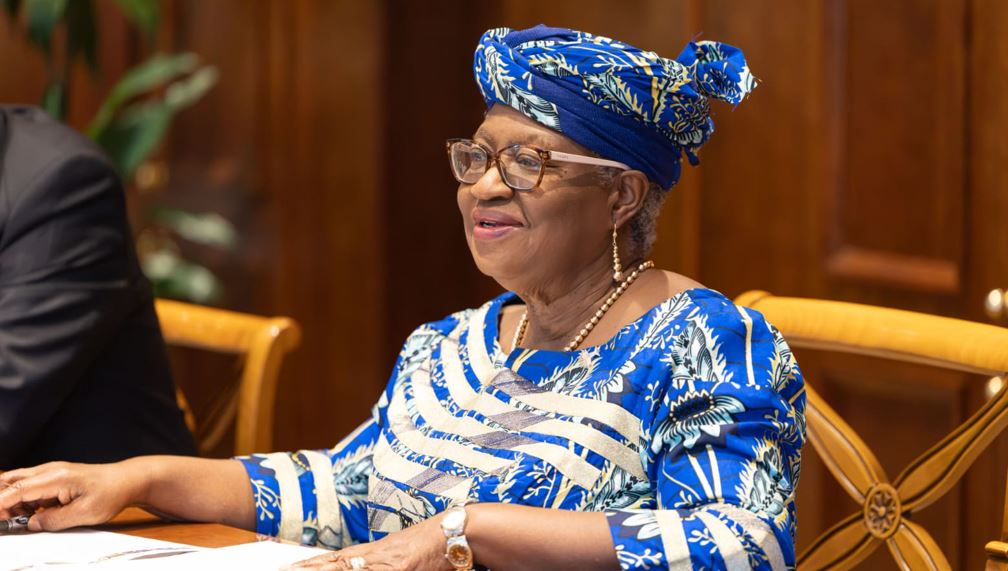
Okonjo-Iweala says demand for semiconductors, processors and data-centre equipment is strengthening international trade despite tariffs and geopolitical disruptions.
GENEVA, SWITZERLAND – Artificial intelligence (AI) has emerged as one of the most significant drivers of international merchandise trade, accounting for nearly half of global goods trade growth this year as demand for semiconductors, processors and data-centre equipment continues to expand.
World Trade Organization (WTO) Director-General Dr Ngozi Okonjo-Iweala revealed the growing influence of AI on international commerce during a media engagement at the WTO headquarters in Geneva on Tuesday, 27 October 2026.
“Almost half of the growth in global goods trade this year is being driven by AI-related goods: processors, semiconductors and equipment used to build data centres and the AI ecosystem,” she said.
The WTO’s October 2026 Global Trade Outlook and Statistics report revised its forecast for global merchandise trade volume growth from 1.9 percent to 3.9 percent for 2026, reflecting stronger-than-expected performance.
AI-enabling goods accounted for approximately 47% of global merchandise trade growth in value terms during the first half of 2026, according to WTO figures.
The rapid expansion of trade in these products has become an important factor in understanding why international commerce has continued to perform despite the difficult global economic environment.
However, Okonjo-Iweala cautioned that the strong performance of technology-related products did not necessarily reflect equally strong growth across all sectors of the international economy.
“This strength may mask weakness in other sectors affected by tariffs and conflicts,” she said.
The Director-General identified North America, particularly the United States, and East Asia as the principal regions benefiting from the expansion of AI-related trade, noting their position reflects the concentration of investment and productive capacity associated with the rapidly developing artificial intelligence industry.
Beyond its immediate contribution to merchandise trade, the Director-General highlighted the longer-term potential of artificial intelligence to transform international commerce.
“A WTO study suggests AI could increase global trade by 40% by 2040, provided its benefits are inclusive,” she said.
Okonjo-Iweala spoke on opportunities artificial intelligence and digital trade presents for smaller economies, including countries in the Caribbean and Pacific regions.
She identified digital infrastructure, regulatory frameworks, legislation, skills and investment attraction among the requirements for countries seeking to participate more effectively in technology-driven international commerce.
She referred to data centres and related services as potential areas of economic activity, while acknowledging the substantial infrastructure and water requirements associated with such facilities.
Her remarks placed the development of technological capabilities alongside traditional trade infrastructure as an increasingly important consideration for economies seeking to participate in emerging international markets.
She continued to speak to the relationship between technological development and international trade rules, acknowledging that the global trading system needed to respond to emerging economic activities and the challenges associated with technological change.
“Resilience is not the same as robustness. Robustness means being able to respond positively to shocks. The WTO must anticipate chokepoints, modernise its rules and reform so it can respond quickly.”
The expansion of AI-related trade she highlighted comes at a time when the international trading environment faces considerable pressure, citing tariff measures, geopolitical tensions and disruptions affecting major shipping routes, including the Black Sea, Red Sea and Strait of Hormuz, among the challenges confronting international commerce.
“These are among the most serious challenges to the global trading system in decades. Yet the system has proved resilient,” she said.
Despite these pressures, the WTO chief maintained that international trading rules continued to provide an important degree of predictability for businesses and investors.
“WTO rules continue to provide an island of predictability amid uncertainty,” she said.
“For businesses and investors, uncertainty is the greatest challenge.”
The Director-General’s engagement took place during the WTO’s Aid for Trade Global Review Week, which marks 20 years of efforts to help developing and least-developed countries strengthen their participation in international commerce.
Summary
- The Director-General identified North America, particularly the United States, and East Asia as the principal regions benefiting from the expansion of AI-related trade, noting their position reflects the concentration of investment and productive capacity associated with the rapidly developing artificial intelligence industry.
- She continued to speak to the relationship between technological development and international trade rules, acknowledging that the global trading system needed to respond to emerging economic activities and the challenges associated with technological change.
- The expansion of AI-related trade she highlighted comes at a time when the international trading environment faces considerable pressure, citing tariff measures, geopolitical tensions and disruptions affecting major shipping routes, including the Black Sea, Red Sea and Strait of Hormuz, among the challenges confronting international commerce.
Co-Owner and Managing Editor of Newsday Media Lesotho. PEPFAR Media champion, Award wining features journalist, an Investigative journalist, REPSSI CAB member. Maseru, Lesotho Joined November 2009.