
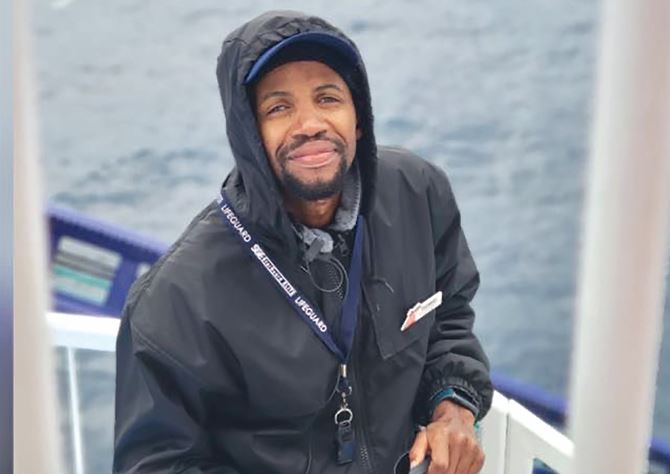
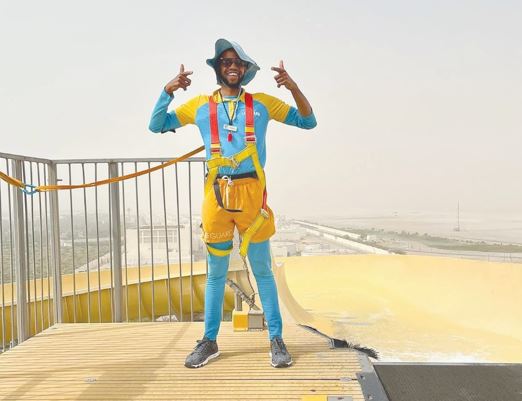
From a school swimming pool in Mafeteng to working on international cruise ships, Motlatsi Mokala has turned lifesaving into a global career, proving that even a young man from a landlocked country can make waves across the world.
In a country without oceans, it is easy to assume that water would never shape a person’s destiny.
But for Motlatsi Mokala, a young man from Matelile in Mafeteng, water became both a calling and a passport to the world. Today, Mokala works across international waters, having built a career that has taken him from Lesotho to the Middle East and the United States.
Yet his journey did not begin with ambition, it began with limitation.
“I was not good at sports like soccer,” he recalled.
“But my school had a swimming pool, and I could float. No one taught me how to swim, I later realised I was doing everything wrong.”
It was at Moshoeshoe II High School where things began to change. What started as an extracurricular activity in the swimming club evolved into something far more meaningful when Peace Corps volunteers introduced structured swimming lessons, and eventually, lifesaving training.
“That’s when everything clicked. Lifesaving showed me that I could rescue someone in their time of need,” Mokala said.
The calling was also deeply personal. As a child, Mokala survived a near-drowning incident after being thrown into a river. Instinct kept him alive, but the experience left a lasting impression.
“That moment stayed with me. It made me realise how important it is to know what to do in water.”
Working as a lifesaver in Lesotho came with its own challenges, many of them structural. People often expected lifesaving services for free, with little awareness of the skill, risk and training involved.
“People often expect you to save lives for free. There’s still a lack of awareness that this work comes at a cost.”
Inconsistent deployment also meant that lifesavers were sometimes assigned to unrelated duties, at times placing them in risky situations. Despite this, Mokala remained committed, even as he recognised that the issue extended beyond Lesotho.
“Even internationally, lifesavers are underpaid, but that is slowly starting to change.”
His breakthrough came through professional networks. An unexpected opportunity in the Gulf region emerged after a former instructor noticed his involvement in a programme with the Lesotho Defence Force.
While initially presented with an option in Dubai, Mokala instead pursued an opportunity in Qatar, where his former instructor was working.
“He told me, ‘At least now lifesaving pays. But I had to explain that back home, it was still mostly voluntary. That’s when he connected me to the opportunity,” Mokala recalled.
In Qatar, Mokala spent over a year refining his skills in a more structured and demanding environment.
“There wasn’t much culture shock. I found it interesting more than anything. I was focused, I was there to work and build a life.”
That experience opened the door to even greater opportunities. Mokala transitioned into working on cruise ships, a move that has taken him across multiple continents and into some of the world’s busiest maritime environments, including the United States.
“I have worked across different places like New Orleans and Los Angeles, with Florida being one of the main docking points,” he explained.
The role requires rigorous training, including certifications in first aid, rescue techniques, emergency response scenarios, and strict adherence to chain-of-command systems. Yet, despite the scale and intensity of the work, Mokala says the core purpose has never changed.
“It’s always fulfilling to identify someone in distress and step in to help.”
One of his most defining moments involved performing CPR on a passenger who had suffered a heart attack.
“I had to resuscitate them. Moments like that stay with you.”
In a profession defined by urgency, Mokala’s approach is grounded in composure.
“I never feel pressure during a rescue,” he says. “Everyone plays their role, the rescue team, medical staff, law enforcement. You focus on what needs to be done.”
So far, he is proud to say that none of his rescue experiences have resulted in a fatality.
Beyond the technical demands of the job, Mokala has also found himself becoming an informal ambassador for Lesotho. His story often sparks curiosity among those he meets.
“People always ask how I can swim when I come from a landlocked country,” he says. “It surprises them.”
These moments have become opportunities to share more about his home country.
“It gives me pride. It keeps me on my toes because I know I’m representing my country.”
Mokala describes his journey as the fulfilment of a long-held dream. As a young boy, he once told his father he wanted to become a pilot. His father’s response has stayed with him ever since.
“He said, ‘If you don’t make it, at least be a passenger.’ Today, I’m living that life, I travel the world, and I’m paid for it.”
From Mafeteng to international waters, his story challenges the limits often placed on young Basotho.
“I never allowed myself to think that where I come from defines where I can go.”
While he remains deeply connected to Lesotho, his future is still unfolding abroad.
“I love Lesotho, but I’m not sure about returning permanently right now. I visit whenever I can.”
For those who hope to follow a similar path, his advice is clear.
“It is not easy, especially the application process. But stay focused, seek the right information, and don’t limit yourself. Opportunities are there, you just have to be ready.”
Summary
- From a school swimming pool in Mafeteng to working on international cruise ships, Motlatsi Mokala has turned lifesaving into a global career, proving that even a young man from a landlocked country can make waves across the world.
- But for Motlatsi Mokala, a young man from Matelile in Mafeteng, water became both a calling and a passport to the world.
- An unexpected opportunity in the Gulf region emerged after a former instructor noticed his involvement in a programme with the Lesotho Defence Force.

A Professional Communications practitioner with a wealth of expertise in marketing, public speaking, communication and media relations. I believe in learning everyday and improving one’s personal and professional capabilities.
* A former journalist and radio host who is passionate about media and it’s impact on society.