
Theko Tlebere
Being a National Development scholar myself, I have learned to closely follow development debates on social media and try to look at them from a view that will educate rather than just debate. The inauguration of the Senqu Bridge, a few weeks ago in Mokhotlong, presented us young people of this country a pivotal question: Does the construction of a bridge inherently constitute development? The response is nuanced. A bridge may serve as a substantial catalyst for development, contingent upon its capacity to enhance the quality of life for individuals, broaden economic opportunities, safeguard communities, and yield enduring national benefits beyond the ceremonial aspects of its inauguration. But before I get deeper into our arguments for today, I will first give a detailed scholarly in-context explanation of what development is, and then we can talk about the Senqu Bridge later.
Development is a multidimensional process through which individuals, institutions, and communities enhance human well-being by engaging in and implementing socially responsible decisions. These decisions are intended to improve individuals’ life chances without diminishing opportunities for others. Consequently, development transcends mere economic growth, infrastructure expansion, or increased income; it encompasses the intricate interplay of economic, sociological, and ethical dimensions of social change.
From an economic perspective, development emphasises the enhancement of material conditions and access to resources. Sociologically, it entails the transformation of social structures, relationships, and institutions that influence individuals’ opportunities. Ethically, it necessitates that these advancements promote public welfare, equity, and accountability. Oberle, Stowers, and Darby (1974) articulate a definition of development as a process wherein a greater number of community members engage in socially responsible decision-making, resulting in an increase in the life chances of certain individuals without compromising those of others.
This definition is significant as it redirects the focus from perceiving development solely as a technical or economic outcome to understanding it as a human and social process, wherein individual behaviour and structural conditions must collaborate to advance both private and collective welfare (Oberle et al., 1974).
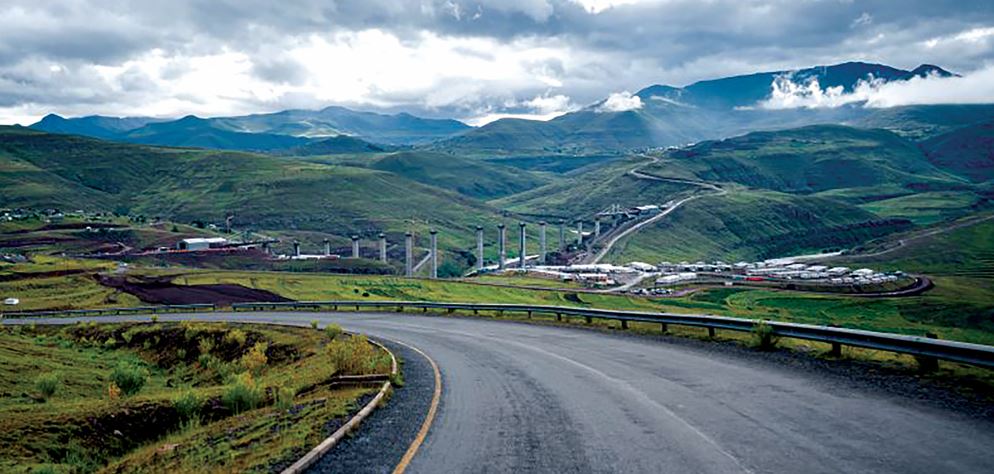
Having made that definition, let’s turn our focus back to the Senqu Bridge, which transcends the ordinary. That bridge is integral to Phase II of the Lesotho Highlands Water Project, a significant bilateral initiative between the Kingdom of Lesotho and the Republic of South Africa. The bridge spans approximately 825 meters in length and stands approximately 90 meters in height, engineered to maintain road connectivity subsequent to the inundation of existing routes by the Polihali reservoir. It constitutes a component of the overarching infrastructure associated with the Polihali Dam and the transference of water from Lesotho to South Africa.
In a limited but broad context, the Senqu Bridge qualifies as development. It represents physical infrastructure that enhances connectivity, facilitating the transit of individuals, goods, services, emergency vehicles, construction materials, and prospective economic activities. For the communities situated in the highlands of Mokhotlong, a dependable crossing is not merely a luxury; it is a prerequisite for access to markets, healthcare facilities, educational institutions, administrative services, and national roadways. Thus, the bridge embodies more than mere concrete and steel; it serves as a conduit through which the state can augment its visibility to remote communities.
Nevertheless, development should not be conflated with mere construction. The efficacy of development must be evaluated by its outcomes rather than the dimensions of the structure itself. A nation may erect formidable infrastructure while its citizens remain impoverished, unemployed, displaced, or excluded from the attendant benefits. Consequently, the Senqu Bridge must be assessed not solely as an engineering feat, but as a significant development intervention.
The most compelling argument for the bridge’s developmental value lies in its role within a project capable of generating national revenue. The Lesotho Highlands Water Project enhances Lesotho’s status as a supplier of water to the Gauteng province of South Africa, specifically to Johannesburg. Recent reports indicate that the project is anticipated to elevate Lesotho’s water exports from approximately 780 million cubic meters annually to over 1.27 billion cubic meters annually upon the completion of Phase II. For a small, landlocked economy with limited industrial capacity, revenue derived from water royalties and the associated infrastructure presents a crucial avenue for development financing.
This consideration is of paramount importance. Lesotho has historically grappled with issues of unemployment, poverty, fiscal constraints, inadequate industrial diversification, and significant reliance on external income sources. Should water revenue be transparently managed and allocated towards health, education, agriculture, rural infrastructure, energy, and productive sectors, then the Senqu Bridge would become a component of a comprehensive national development strategy. Conversely, if such revenues are misappropriated for recurrent expenditures, elite contracts, ineffective procurement processes, and political favouritism, then the bridge may devolve into a symbol of squandered potential.
There is another aspect that should not be ignored while talking about the Senqu Bridge: the employment aspect is equally significant. Reports indicate that the construction of the bridge resulted in the creation of approximately 1,200 jobs, primarily for residents of Lesotho. This is particularly noteworthy in a nation where employment opportunities are limited. However, temporary employment during construction is insufficient. Genuine development necessitates skills transfer, local subcontracting, engineering training, maintenance capabilities, and sustained employment associated with the infrastructure corridor. A bridge that provides temporary jobs for Basotho is beneficial; a bridge that cultivates Basotho’s technical expertise over an extended period constitutes true development.
The bridge also embodies regional developmental implications. It illustrates that Lesotho is not merely a small nation encircled by South Africa, but rather a strategic ally in regional water security. The South African government has characterised the project as a facet of longstanding bilateral cooperation within the framework of the Lesotho Highlands Water Project. This positioning affords Lesotho leverage, contingent upon its judicious application. Water represents a strategic resource; Lesotho must not perceive it solely as a raw export commodity. Instead, it should engage in water diplomacy to negotiate enhanced infrastructure, energy security, training opportunities, market access, and investment in affected communities.
However, the critical elements of this discourse must not be overlooked. The Lesotho Highlands Development Authority (LHDA) has acknowledged that Phase II necessitates land acquisition from local communities, with approximately 5,000 hectares of land projected to be submerged by the Polihali Dam and reservoir within the Senqu and Khubelu river valleys. This underscores that development incurs costs. Certain households will be compelled to relinquish land, grazing territories, agricultural fields, cultural sites, or established ways of life. Should compensation be delayed, insufficient, or ineffectively administered, the project that is lauded nationally may be perceived locally as a source of loss.
It is critical that villagers from the affected areas learn about the project at the transparency exhibition. A bridge may facilitate connections while simultaneously severing individuals from their land. It may generate national revenue while imposing local sacrifices. It may bolster South Africa’s water security while leaving affected Basotho to ponder in thirst and hunger: What, precisely, have we gained? Thus, development must encompass compensation, resettlement justice, livelihood restoration, local procurement, social services, and ongoing consultation with impacted communities.
The Senqu Bridge should also be evaluated in terms of maintenance. Numerous African governments celebrate new infrastructure, but frequently neglect maintenance funding. A bridge constitutes development only if it remains safe, functional, and integrated into a viable transportation system. The thinking should already be directed towards roads deteriorating, maintenance budgets proving inadequate, or local communities being unable to afford transportation costs; the developmental value diminishes.
Infrastructure is not established solely on inauguration day; it is sustained through ongoing governance.
Therefore, is the Senqu Bridge indeed a development? Yes, but conditionally. It constitutes development if it enhances mobility, safeguards highland connectivity, supports water revenue, creates local opportunities, strengthens regional cooperation, and leaves affected communities in an improved state. It does not constitute development if it devolves into a mere monument for political figures, a conduit for water exports, or a project whose advantages are national and regional while its burdens are localised.
For the Kingdom of Lesotho, the pertinent inquiry is not merely whether the Senqu Bridge is aesthetically pleasing, costly, or technically remarkable. The essential question is whether a child in Mokhotlong, a farmer in the Polihali region, a small trader, a nurse, a teacher, or a taxi operator will perceive the bridge as a tangible enhancement in their daily existence. If the response is affirmative, then the bridge is a development. If the response is negative, then it is merely infrastructure.
For me, I see the Senqu Bridge as an inception rather than a conclusion. It presents Lesotho with a rare opportunity to convert geographic challenges into development financing, transform water into negotiating leverage, and facilitate social transformation through infrastructure. However, this endeavour will necessitate accountable governance. The bridge has been constructed. The true test of development commences now. The future is NOW!
Summary
- A bridge may serve as a substantial catalyst for development, contingent upon its capacity to enhance the quality of life for individuals, broaden economic opportunities, safeguard communities, and yield enduring national benefits beyond the ceremonial aspects of its inauguration.
- Oberle, Stowers, and Darby (1974) articulate a definition of development as a process wherein a greater number of community members engage in socially responsible decision-making, resulting in an increase in the life chances of certain individuals without compromising those of others.
- This definition is significant as it redirects the focus from perceiving development solely as a technical or economic outcome to understanding it as a human and social process, wherein individual behaviour and structural conditions must collaborate to advance both private and collective welfare (Oberle et al.

Welcome to Newsday Media – Your Trusted Source for News and Insights in Lesotho!
At Newsday Media, we are passionate about delivering accurate, timely, and engaging news and multimedia content to our diverse audience. Founded with the vision of revolutionizing the media landscape in Lesotho, we have grown into a leading hybrid media company that blends traditional journalism with innovative digital platforms.
Our mission is simple: to inform, inspire, and empower our readers by providing comprehensive coverage of local and global events, current affairs, and cultural happenings. Whether you’re looking for breaking news, in-depth analysis, or captivating storytelling, Newsday Media is your go-to destination for all things news-related.
With a dedicated team of journalists, editors, and multimedia experts, we are committed to upholding the highest standards of journalistic integrity and professionalism. We pride ourselves on delivering content that not only informs but also sparks conversation, fosters understanding, and drives positive change in our society.
From our flagship newspaper to our dynamic digital platforms, we offer a wide range of multimedia content to cater to the diverse interests and preferences of our audience. Whether you prefer to stay informed through print, online articles, videos, or podcasts, Newsday Media has something for everyone.
We believe in the power of storytelling to connect people, bridge divides, and inspire action. That’s why we’re dedicated to providing a platform for voices from all walks of life, championing diversity, inclusion, and authenticity in everything we do.
Thank you for visiting Newsday Media. We invite you to explore our website, engage with our content, and join us on our journey to inform, inspire, and empower our community. Together, let’s shape the future of media in Lesotho.