“I warned PM Thabane against his love affair at Moshoeshoe II,” Kamoli claims
Former Lesotho Defence Force Commander Lt Gen Tlali Kamoli has told the High Court that he warned then Prime Minister Thomas Thabane against visiting his girlfriend at Moshoeshoe II before the January 2014 bomb attacks. Kamoli denied ordering the attacks, rejected testimony linking him to the bombings, and maintained he had no involvement in the incidents as his trial continues before the High Court.
I am a journalist based in Maseru, Lesotho, renowned for investigative reporting. Over the years, my work has been published both locally and internationally, including in South Africa through the Amabhungane Centre for Investigative Journalism and the Daily Maverick, among other publications.
In Lesotho, I have served as a senior reporter for several leading weekly newspapers, including the Lesotho Times, Public Eye, and Sunday Express. My reporting has focused on uncovering issues of public interest, promoting accountability, and giving voice to underreported stories.
In 2016, I co-founded the MNN Centre for Investigative Journalism in Maseru, an initiative dedicated to strengthening investigative journalism and fostering a culture of transparency and public-interest reporting in Lesotho.
…the incarcerated army commander distances himself from 2014 explosive attacks at Moshoeshoe II and Ha-Abia
…rubbishes claims that he plotted the attacks
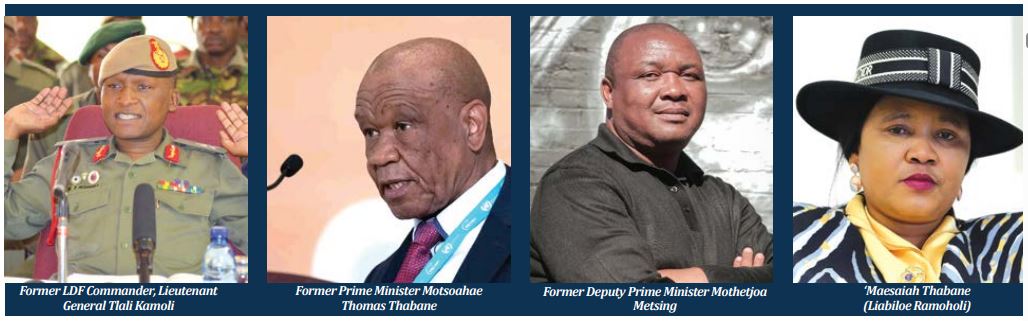
The former Lesotho Defence Force (LDF) Commander, Lieutenant General Tlali Kamoli, has told the High Court that he warned Prime Minister Motsoahae Thomas Thabane against his relationship with his then-girlfriend, Liabiloe Ramoholi, at Moshoeshoe II in Maseru, before the coordinated late-night explosive attacks on January 27, 2014, at Moshoeshoe II and Ha-Abia.
The attacks targeted the home of Ramoholi (who later married Thabane and became First Lady ‘Maesaiah Thabane) in Moshoeshoe II and the residence of then Police Commissioner Khothatso Tšooana in Ha-Abia. The bombings sent shockwaves across the nation.
The trial, presided over by Justice Charles Hungwe, sees Kamoli and several army members – Sergeant Pitso Ramoepana, Second Lieutenant Litekanyo Nyakane, Corporal Heqoa Malefane, and Lance Corporal Mohlalefi Seitlheko –facing charges of attempted murder and malicious damage to property. Kamoli also faces an additional charge of obstruction of justice.
Kamoli’s testimony: A warning unheeded
Taking the stand as Accused 1 on Monday, Kamoli testified that he had met with the prime minister ahead of the bombing attacks and raised concerns about his safety.
Led by his defence lawyer, Advocate Letuka Molati, Kamoli told the court that during their meeting, Thabane informed him that since he had no wife, he was in a relationship with his girlfriend residing at Moshoeshoe II, Liabiloe Ramoholi.
“He said he would go and visit her at Moshoeshoe II. I then warned him against that. I said it was not safe anymore for him, as the prime minister, to be seen in love affairs at places like Moshoeshoe II,” Kamoli testified.
He suggested that it would be safer if the girlfriend could be fetched by a soldier from his guard and ferried to State House whenever the prime minister wanted to meet her.
“I told him it was risky for the prime minister to be there at any awkward moment,” Kamoli said.
However, Thabane did not heed Kamoli’s advice. Instead, Kamoli told the court, the prime minister requested that he provide a team of soldiers to escort him to Moshoeshoe II to see his girlfriend there.
Kamoli added that he is a respectful person who heeds the instructions of his elders.
“I am a child well-raised. I was taught well by my father, who always said to me that I should always obey the elderly but not be afraid to speak my mind,” he said.
It was on this principle, Kamoli explained, that he did not insist further on his advice to Thabane.
“I listened to him and provided him with a team of highly trained soldiers to always escort him to his girlfriend’s place,” he said.
Kamoli rebuts Mokaloba’s testimony
Kamoli sharply rebuked the testimony of Major General Ramanka Mokaloba, who had previously implied that Kamoli was the one who ordered the bombings at Moshoeshoe II and Ha-Abia.
On July 24, 2024, during his evidence-in-chief, Major General Mokaloba testified that Kamoli had told him about a plan to attack the homes of Liabiloe Ramoholi and Khothatso Tšooana. Mokaloba claimed that in January 2014, Kamoli summoned him to his office at Ratjomose Barracks and outlined a plan to stage shootings near the two residences.
Mokaloba further alleged that Kamoli intended the operation to appear as an internal police feud stemming from a dispute between then Deputy Commissioner of Police Keketso Monaheng and Commissioner Tšooana. According to Mokaloba, Kamoli’s ultimate goal was to destabilise the police and position the army as the primary security for Prime Minister Thabane, thereby consolidating his control over the security forces.
But Kamoli dismissed Mokaloba’s testimony outright this week, stating that Mokaloba had never even attempted to meet with him to discuss the subject. Kamoli insisted that he had never issued any instructions to anyone related to the attacks at Moshoeshoe II or Ha-Abia.
Security committee meeting drama
Kamoli further testified that after the bombing incident, he was invited to a Security Committee meeting convened by the committee’s chairman, then Deputy Prime Minister Mothetjoa Metsing. Also present were the then Director General of the National Security Service (NSS), Mohlakala Lerotholi, and Cabinet Ministers Thesele ‘Maseribane and Molobeli Soulo. Kamoli told the court that all members were present except Tšooana.
Instead of attending himself, Kamoli said, Tšooana had instructed Deputy Commissioner of Police (DCP) Masupha Masupha to attend on his behalf.
The members were not happy with Tšooana’s behaviour, which Kamoli said they described as “undermining and disrespecting” the chairman of the Committee and Deputy Prime Minister Metsing.
Kamoli said Metsing dismissed Masupha from the meeting, stating that he had invited Tšooana, not Masupha.
“He wanted Tšooana, not Masupha, in that meeting,” Kamoli told the court.
Shortly thereafter, Kamoli said, Lerotholi received a call from the then Principal Secretary in the Ministry of Defence, David Sehloho.
“Sehloho told Lerotholi that the Director General of NSS should not have attended the meeting because they had already established that it was Honourable Metsing and I who were involved in the bombing attacks at Moshoeshoe II and Ha-Abia,” Kamoli said.
He said all members were surprised by the revelation. Kamoli also testified that PS Sehloho had confessed that he was the one who instructed Tšooana not to attend the meeting because it had been convened by the suspects in the bombing attacks.
Kamoli’s surprise at police investigations
Kamoli said he contacted Tšooana the following day to request an update on the investigations relating to the bombings. He expressed surprise when the police commissioner told him that they had already made progress with the assistance of the South African Police Service (SAPS).
Kamoli said he was surprised because the police were supposed to conduct the investigations together with the army, as had been instructed by Prime Minister Thabane.
The trial continues before Justice Hungwe in the High Court.
The January 27, 2014 attacks occurred during one of the most turbulent periods in Lesotho’s coalition government, formed after the 2012 general election.
Prime Minister Thabane’s coalition administration, which included the All Basotho Convention (ABC), Lesotho Congress for Democracy (LCD) led by Deputy Prime Minister Metsing, and the Basotho National Party (BNP) led by ‘Maseribane, had become deeply divided over governance and control of the country’s security institutions.
Relations between LDF, under Lieutenant General Kamoli, and the Lesotho Mounted Police Service (LMPS), led by Commissioner Tšooana, had deteriorated sharply.
Tensions were fuelled by allegations of political interference, rivalry between the military and police, and competing loyalties within the coalition government.
The bombings intensified an already volatile political and security crisis that culminated months later in the suspension of Parliament, the attempted removal of Kamoli as army commander, and the August 30, 2014, military operation that forced Prime Minister Thabane to flee temporarily to South Africa, the subsequent Southern African Development Community (SADC)-brokered Maseru Facilitation Process, and the snap general election of February 2015.
Kamoli has been in remand prison since 2017 on multiple charges.
The trial, which has been running intermittently for several years before the High Court, forms part of a broader series of criminal proceedings arising from Lesotho’s political and security instability between 2014 and 2017, a period that prompted repeated interventions by SADC and ultimately the establishment of the regional commission of inquiry led by Justice Mpaphi Phumaphi after the killing of former army commander Lieutenant General Maaparankoe Mahao in June 2015.
Summary
The former Lesotho Defence Force (LDF) Commander, Lieutenant General Tlali Kamoli, has told the High Court that he warned Prime Minister Motsoahae Thomas Thabane against his relationship with his then-girlfriend, Liabiloe Ramoholi, at Moshoeshoe II in Maseru, before the coordinated late-night explosive attacks on January 27, 2014, at Moshoeshoe II and Ha-Abia.
Led by his defence lawyer, Advocate Letuka Molati, Kamoli told the court that during their meeting, Thabane informed him that since he had no wife, he was in a relationship with his girlfriend residing at Moshoeshoe II, Liabiloe Ramoholi.
Instead, Kamoli told the court, the prime minister requested that he provide a team of soldiers to escort him to Moshoeshoe II to see his girlfriend there.
I am a journalist based in Maseru, Lesotho, renowned for investigative reporting. Over the years, my work has been published both locally and internationally, including in South Africa through the Amabhungane Centre for Investigative Journalism and the Daily Maverick, among other publications.
In Lesotho, I have served as a senior reporter for several leading weekly newspapers, including the Lesotho Times, Public Eye, and Sunday Express. My reporting has focused on uncovering issues of public interest, promoting accountability, and giving voice to underreported stories.
In 2016, I co-founded the MNN Centre for Investigative Journalism in Maseru, an initiative dedicated to strengthening investigative journalism and fostering a culture of transparency and public-interest reporting in Lesotho.
To ensure optimal experiences, we utilize technologies such as cookies to store and/or access information from your device. Granting consent to these technologies enables us to process data, including browsing habits or unique identifiers on this website. Conversely, not consenting or revoking consent may negatively impact specific features and functionalities.
Functional
Always active
The technical storage or access is strictly necessary for the legitimate purpose of enabling the use of a specific service explicitly requested by the subscriber or user, or for the sole purpose of carrying out the transmission of a communication over an electronic communications network.
Preferences
The technical storage or access is necessary for the legitimate purpose of storing preferences that are not requested by the subscriber or user.
Statistics
The technical storage or access that is used exclusively for statistical purposes.The technical storage or access that is used exclusively for anonymous statistical purposes. Without a subpoena, voluntary compliance on the part of your Internet Service Provider, or additional records from a third party, information stored or retrieved for this purpose alone cannot usually be used to identify you.
Marketing
The technical storage or access is required to create user profiles to send advertising, or to track the user on a website or across several websites for similar marketing purposes.