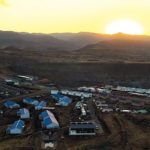
After forty years Lesotho and South Africa signed the Lesotho Highlands Water Project (LHWP) Treaty at the Pitso Ground in Maseru on 24 October 1986, the Lesotho Highlands Development Authority (LHDA) has published its first-ever integrated report.
Covering the period April 2024 to March 2025, it reads as both a scorecard and an admission. After four decades of implementation, the Treaty’s core promises have largely been delivered, but Phase II is behind in places and some communities are still waiting for promised benefits.
Phase I moved quickly. Katse Dam’s impoundment began on 20 October 1995, and by September 1996 the reservoir had reached its target level months ahead of schedule, according to the report’s milestone timeline.
Phase 1A was commissioned in December 1996, water transfer was inaugurated on 22 January 1998, and ‘Muela Hydropower Station followed a year later. The report describes Katse as “a striking piece of modern engineering”, one of fewer than 30 double-curvature concrete arch dams in the world.
Those assets still deliver. The system is designed to transfer 780 million cubic metres of water a year to South Africa’s Vaal system, supplying more than 16 million people in Gauteng. Even with a six-month tunnel maintenance shutdown, 506.7 million cubic metres were delivered in the year under review, against a plan of 504 million.
For Lesotho, the returns are fiscal. The report calls the LHWP “the third-largest contributor to Lesotho’s fiscus”, with about M2.9 billion in royalties in the year and M17 billion since inception. Royalties and electricity revenue account for 18% of projected government income in the 2026 financial year.
The project has also been a significant employer and builder. About 16,000 jobs in Phase I and 11,000 in Phase II, over 1,000 kilometres of roads and bridges, and water and sanitation for 126 villages are cited in the report.
‘Muela has generated more than 12 million megawatt hours of electricity since commissioning. Local suppliers received M1.2 billion in Phase I and M366 million so far in Phase II. The LHDA’s financial statements have drawn an unqualified audit opinion “for over 10 years”.
The Treaty’s environmental duties have left a mark too. Katse Botanical Garden grew out of the Treaty requirement to safeguard the environment, while Bokong Nature Reserve and Tsehlanyane National Park protect fragile highland ecosystems.
Phase II, a M53 billion commitment, is the next chapter. Its agreement was signed in August 2011 and ratified in May 2013. By March 2025 overall progress stood at 42.8% against 40% planned.
Polihali Dam was 27% complete, the 38-kilometre transfer tunnel 39% and Senqu Bridge 77.7%. When finished, the works will lift transfer capacity from 780 to 1,280 million cubic metres a year and raise ‘Muela’s output by 30%.
The report does not hide the difficulties. “Implementation of Phase II continued to experience some delay challenges during the year,” said LHDA Chief Executive Tente Tente, citing contractor performance and supply chain constraints.
The 42.8% figure was “buoyed by carried-over advance works”, while main works lagged because of productivity constraints, resource deployment challenges and work and residence permitting delays.
The delays carry a human cost. The LHDA disbursed only M133.6 million of the M708.8 million budgeted for resettlement, and livelihood compensation was underspent by about M575 million. The report blames “slower-than-planned implementation of livelihood restoration programmes”, a delayed release of communal compensation funds and a temporary freeze on some livelihood activities.
Overall spending ran 29% below budget, and the report warns that the outstanding commitments could cause “bunching of expenditures” later.
Some money did reach households. The LHDA paid out M49.9 million in compensation in the year, including M11.4 million in annual cash to 1,589 households, and verified 12,842 assets. Yet the report concedes that “heightened community expectations presented reputational challenges if benefits were delayed.”
Electricity also fell short. ‘Muela generated 261.72 GWh against a 304 GWh target, 13.9% below plan, after a power line trip shut down two generating units and the tunnel shutdown cut water flow.
Trust is another pressure point. Listing misinformation and distrust among its seven material matters, the LHDA warns that “Persistent distrust or hostile sentiment has the potential to escalate into protests, disputes, or legal action”.
Its first reputation survey confirmed recognition of the LHDA’s development role, but also highlighted “the need for greater transparency and visible benefit delivery”. The report also flags ageing infrastructure exposed to “breakdown, theft, and vandalism”, climate risks, skills gaps and performance data that needed manual consolidation.
Looking ahead, management says its focus is “firmly on accelerating delivery and unlocking the remaining bottlenecks that constrain progress.” Impoundment at Polihali is planned for October 2027, the Board has approved a Livelihoods Restoration Master Plan, and work on the Oxbow Hydropower Project has begun.
The report describes the LHDA’s vision as “a shift from building projects to building prosperity”. Whether Basotho communities feel that shift will depend on how quickly the compensation and livelihood programmes catch up with the concrete.
Summary
After forty years Lesotho and South Africa signed the Lesotho Highlands Water Project (LHWP) Treaty at the Pitso Ground in Maseru on 24 October 1986, the Lesotho Highlands Development Authority (LHDA) has published its first-ever integrated report.
About 16,000 jobs in Phase I and 11,000 in Phase II, over 1,000 kilometres of roads and bridges, and water and sanitation for 126 villages are cited in the report.
The report blames “slower-than-planned implementation of livelihood restoration programmes”, a delayed release of communal compensation funds and a temporary freeze on some livelihood activities.
To ensure optimal experiences, we utilize technologies such as cookies to store and/or access information from your device. Granting consent to these technologies enables us to process data, including browsing habits or unique identifiers on this website. Conversely, not consenting or revoking consent may negatively impact specific features and functionalities.
Functional
Always active
The technical storage or access is strictly necessary for the legitimate purpose of enabling the use of a specific service explicitly requested by the subscriber or user, or for the sole purpose of carrying out the transmission of a communication over an electronic communications network.
Preferences
The technical storage or access is necessary for the legitimate purpose of storing preferences that are not requested by the subscriber or user.
Statistics
The technical storage or access that is used exclusively for statistical purposes.The technical storage or access that is used exclusively for anonymous statistical purposes. Without a subpoena, voluntary compliance on the part of your Internet Service Provider, or additional records from a third party, information stored or retrieved for this purpose alone cannot usually be used to identify you.
Marketing
The technical storage or access is required to create user profiles to send advertising, or to track the user on a website or across several websites for similar marketing purposes.