
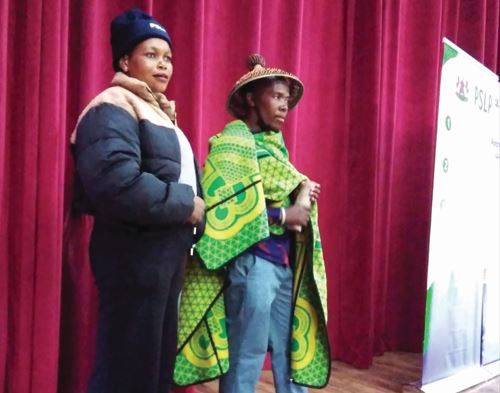
‘Marelebohile Moloinyane now employs two people after turning crochet skill into thriving business’
Many people believe that a small amount of money, like M5,400, cannot make a real difference in someone’s life, especially with today’s high cost of living. But for 35-year-old ‘Marelebohile Moloinyane from Quthing, Tosing Community Council, this money was a turning point that brought hope not only to her but also to others in her village.
Moloinyane’s story begins when she heard about the Economic Inclusion Program (EIP) under the Pathways to Sustainable Livelihoods Project from a friend. Curious and determined, she sought more information and eventually applied. Soon, she was selected to join the project and attended six months of training in business and bookkeeping.
The training encouraged participants to think creatively and come up with unique business ideas that would benefit their communities.
For Moloinyane, the answer was close to home. She had learned to crochet hats from her aunt, making them for family and friends. With the program’s support, she decided to turn this skill into a business.
“Many people would say M5,400 is a small amount and cannot change anyone’s life for the better, but it helped me wire my three-roomed house with electricity and plaster it. On top of that, I have two individuals that I have hired, meaning they now have an income for their families,” she said.
She used the grant to buy wool and fix her crochet machine. The timing was perfect, it was winter, and the demand for warm hats was high both locally and beyond the community.
As orders grew, she hired two more people to help her keep up with the demand.
“Because of the demand, I increased the number of people to work with me by hiring two individuals. I then realised that what the Ministry of Gender, Youth and Social Development has done for us is remarkable because I was able to put bread on the table for other families by hiring their members. It means with the help of the ministry and partners, I was also able to invest in others,” she explained.
With careful management and savings from her business, she was able to improve her home by getting electricity and plastering the walls.
Government launches phase II of project
“What started as a small grant has not only changed her life but also created jobs and inspired others in her community,” said Minister of Gender, Youth and Social Development Pitso Lesaoana during the launch of phase II of the project in Thaba Tseka, Mantšonyane, this week.
He said the five-year project, which started in 2022 and ends in 2027, came about after the government of Lesotho saw a need to assist vulnerable unemployed people with the means to start livelihood businesses in their communities.
Lesaoana indicated that in phase I, the project had 4,800 families as beneficiaries with more than M25.9 million to start businesses.
“In phase II, the government is looking to reach 5,000 families with about M27 million, while in Tenesulu council, where Phase II is launched, we will assist 1,000 families,” he said.
World Vision: Programme about dignity and transformation
World Vision International Lesotho National Director James Chefwelu said the second phase is the beginning of a journey of opportunity, dignity, and transformation for 5,000 Basotho, especially women, youth, and persons living with disabilities.
He said the programme is rooted in a shared vision, a Lesotho where the most vulnerable are not merely supported but are fully empowered to thrive, participate meaningfully in the economy, and build sustainable futures.
“As outlined in our national strategy, Lesotho continues to face severe socio-economic challenges. We confront high levels of poverty and vulnerability, particularly in rural areas. Our people experience limited access to productive assets and capital. Furthermore, we must dismantle persistent gender inequalities where women face structural barriers to markets, finance, and decision-making. We must also address the needs of a growing youth population that currently faces limited employment opportunities. Yet, within these deep challenges lie our greatest opportunities ahead,” he said.
Chefwelu said the EIP responds directly to this reality by combining social protection with economic empowerment.
“By building on existing government systems such as the National Information System for Social Assistance (NISSA) and our social assistance programmes, we are systematically moving beneficiaries from dependency to productivity and self-reliance,” he said.
CRS: Phase I reached 99 percent of target
Hopewell Zheke, National Director of Catholic Relief Services (CRS), said phase I program achievements to date include reaching 99 percent (4,968) of their target (5,000) beneficiaries.
“Of those reached, over 60 percent are women and over 40 percent are youth, who were the targets. This means more women and youth in the target community councils got empowered to establish stable sources of livelihood for their households,” Zheke said.
According to Zheke, the most popular businesses among beneficiaries include broiler production, piggery, spaza shops, crop and vegetable farming, selling second-hand clothing, free-range chicken farming, and layers.
Summary
- “What started as a small grant has not only changed her life but also created jobs and inspired others in her community,” said Minister of Gender, Youth and Social Development Pitso Lesaoana during the launch of phase II of the project in Thaba Tseka, Mantšonyane, this week.
- He said the five-year project, which started in 2022 and ends in 2027, came about after the government of Lesotho saw a need to assist vulnerable unemployed people with the means to start livelihood businesses in their communities.
- He said the programme is rooted in a shared vision, a Lesotho where the most vulnerable are not merely supported but are fully empowered to thrive, participate meaningfully in the economy, and build sustainable futures.
Ntsoaki Motaung is an award-winning health journalist from Lesotho, specializing in community health stories with a focus on sexual and reproductive health and rights, as well as HIV. She has contributed to platforms like “Be in the KNOW,” highlighting issues such as the exclusion of people with disabilities from HIV prevention efforts in Lesotho.
In addition to her journalism, Ntsoaki serves as the Country Coordinator for the Regional Media Action Plan Support Network (REMAPSEN). She is also a 2023 CPHIA Journalism Fellow.