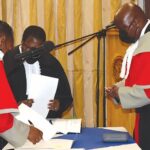

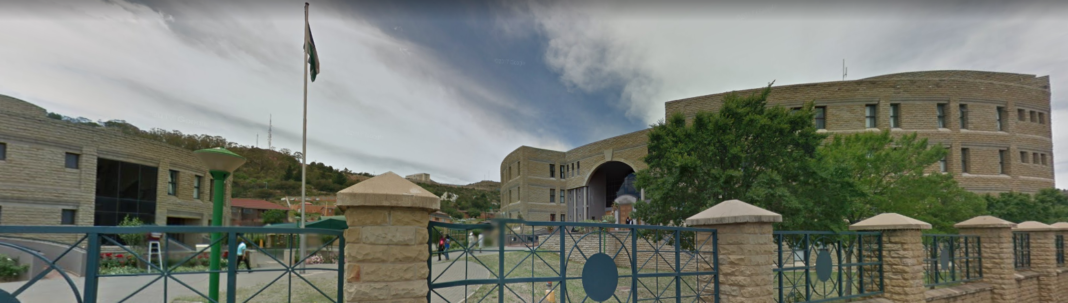
The Judicial Service Commission (JSC) has issued an amended list of potential High Court judges this week, adding three applicants to the race for places on the bench.
The JSC announced on Monday that Tumisang Mosotho, Khasiane Ramathe and Teboho Thoso had been added to the list of applicants. They join the 12 applicants and five nominees published by the JSC last month, bringing the total number of candidates to 20.
The Commission has also announced eight vacancies for Puisne Judges of the High Court of Lesotho, as the judiciary continues to grapple with a shortage of judges and a persistent backlog of cases.
The JSC is the constitutional body responsible for the appointment, promotion, discipline and removal of judicial officers across the country.
It said the resolution to include Mosotho, Ramathe and Thoso “follows their request to be considered for inclusion in the list of Applicants/Nominees published under JSC Circular No.01 of 2026”.
By the closing date for applications, the three had submitted all forms and supporting documents “except the “Application/Nomination” forms.”
After careful consideration, the Commission concluded “that substantial compliance had been proven because the questionnaire for Applicants/Nominees and background check authorisation forms were duly submitted”.
The Commission has invited members of the public, the Lesotho Council of NGOs (LCN), legal practitioners, the Law Society of Lesotho, the Attorney General, the Director of Public Prosecutions, the Faculty of Law at the National University of Lesotho (NUL) and the Christian Council of Lesotho (CCL) to submit written objections to the candidacy of any nominee or applicant on or before 26 October 2026.
The Commission undertakes to only “consider information that is relevant, credible and capable of verification”.
Where adverse information is received, the JSC says the candidate concerned will be given “reasonable opportunity” to respond before any decision affecting his or her candidature is made. The Commission may disregard comments that are “anonymous, malicious, frivolous, vexatious or unsupported by credible evidence,” reads the circular endorsed by JSC Secretary Advocate Pontšo Phafoli.
The eight successful candidates will be appointed across the three divisions of the High Court. Five will serve in the Main Division in Maseru, two in the Northern Division in Leribe and one in the Southern Division in Mohale’s Hoek. Once appointed and sworn in, the judges are expected to strengthen the judiciary’s capacity and help the courts hear and decide pending cases more quickly.
Judges perform the core judicial function of exercising the judicial power vested in the courts of Lesotho. The Constitution provides that “judicial power shall vest in the courts of Lesotho” and that the courts shall include the Court of Appeal and the High Court, among others.
Members of the public and institutions may nominate potential candidates for the vacancies, and once the names are published, they may also lodge objections for the JSC to consider. Since 2021, candidates for judicial posts have been required to apply and undergo public interviews as part of a competitive appointment process. Previously, the JSC would recommend candidates to His Majesty the King for appointment to the bench.
There are currently 13 substantive judges serving on the High Court, including Chief Justice Sakoane Sakoane. The others are Justices Molefi Makara, Moroke Mokhesi, Polo Banyane, Realeboha Mathaba, Fumane Khabo, ’Maliepollo Makhetha, ’Makampong Mokhoro, ’Mafelile Ralebese, Moneuoa Kopo, Tšeliso Mokoko, ’Mabatšoeneng Hlaele and Itumeleng Shale. Justice ’Maseforo Mahase remains suspended and is engaged in a protracted legal battle over her position.
To address the case backlog and shortage of judges, Chief Justice Sakoane appointed five legal practitioners and judicial officers in September 2025 to serve in an acting capacity. They are Advocate Tsebang Putsoane, Senior Resident Magistrate Palesa Rantara, Senior Resident Magistrate ’Manapo Motebele, Advocate Tšooana Lesaoana and Sekake Malebanye KC.
At the opening of the judicial year earlier this year, Sakoane stressed the importance of judicial independence, saying: “Judicial independence and accountability are non-negotiable.” He said judges must be able to determine cases free from political pressure, economic influence and popular sentiment.
Reporting on the performance of the courts last year, he said the High Court Main Division registered 1,474 cases, with 563 in allocation and 1,090 completed. The Labour Appeal Court registered 47 cases, with 31 allocated and 33 completed. The Commercial Division registered 612 cases, with 112 allocated and 718 completed, while the Northern Division registered 525 cases, with 84 in allocation and 293 completed. Across the courts covered in the report, 2,704 cases were registered, 810 were in allocation and 2,139 were completed.
Sakoane said the efficiency of the courts should be measured by their ability to handle cases within a reasonable time without compromising fairness or the quality of justice.
“Cases that are managed well take relatively shorter time to dispose of,” he said, adding that the time taken to deliver rulings and judgments is an important indicator of effective or ineffective case management.
Summary
- The Commission has also announced eight vacancies for Puisne Judges of the High Court of Lesotho, as the judiciary continues to grapple with a shortage of judges and a persistent backlog of cases.
- The Commission has invited members of the public, the Lesotho Council of NGOs (LCN), legal practitioners, the Law Society of Lesotho, the Attorney General, the Director of Public Prosecutions, the Faculty of Law at the National University of Lesotho (NUL) and the Christian Council of Lesotho (CCL) to submit written objections to the candidacy of any nominee or applicant on or before 26 October 2026.
- Five will serve in the Main Division in Maseru, two in the Northern Division in Leribe and one in the Southern Division in Mohale’s Hoek.
I am a journalist based in Maseru, Lesotho, renowned for investigative reporting. Over the years, my work has been published both locally and internationally, including in South Africa through the Amabhungane Centre for Investigative Journalism and the Daily Maverick, among other publications.
In Lesotho, I have served as a senior reporter for several leading weekly newspapers, including the Lesotho Times, Public Eye, and Sunday Express. My reporting has focused on uncovering issues of public interest, promoting accountability, and giving voice to underreported stories.
In 2016, I co-founded the MNN Centre for Investigative Journalism in Maseru, an initiative dedicated to strengthening investigative journalism and fostering a culture of transparency and public-interest reporting in Lesotho.